Ben Amera
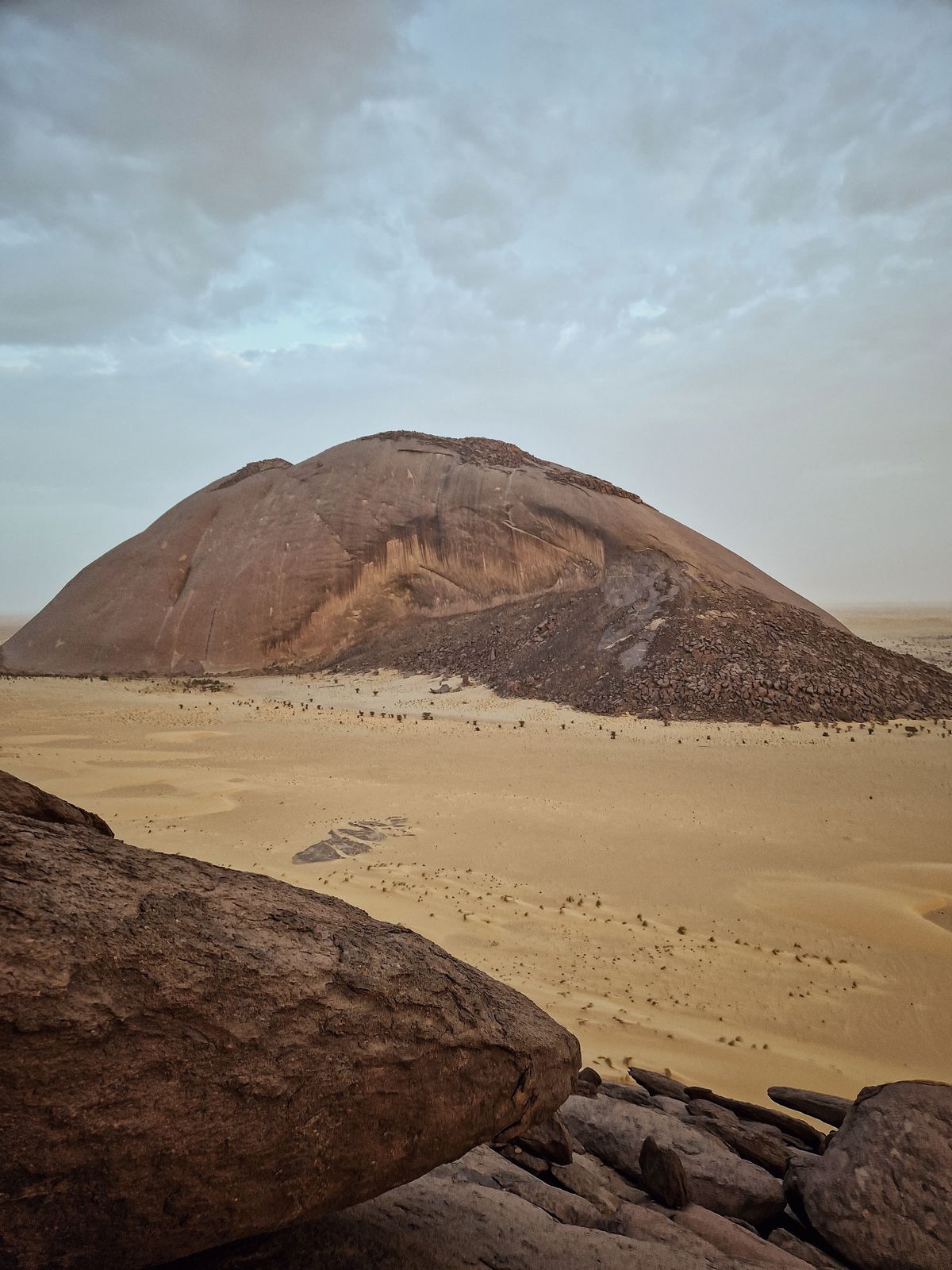
One of the world's largest monoliths, rising from the open Sahara
Overview
In the remote desert of northern Mauritania, far from any city or paved road, a colossal granite mass rises from the flat desert floor. Ben Amera is one of the largest rock outcroppings on Earth — a single granite inselberg that stands approximately 633 metres above its surroundings and covers a surface area that rivals Uluru in Australia. It is one of Mauritania's most visually dramatic natural features and one of the least-visited monuments anywhere in the world.
Ben Amera sits in the Tiris Zemmour region of northern Mauritania, roughly 120 kilometres south of Zouerate and close to the route of the Iron Ore Train. This proximity is both what makes it accessible and what gives visiting it its particular character — the journey here passes through the same raw, mineral-rich desert that the great train crosses, and the landscape around the monolith has the same sense of geological time and planetary scale.
Nearby, the ancient petroglyphs of Amatlich — carved into the rocks by people who lived here thousands of years ago — confirm that this monolith has drawn human attention for millennia. Ben Amera may be unknown to most of the world, but it has always been known by those who live near it.
Ancient Stone, Ancient People
Ben Amera is a geological relic of the Precambrian era — the granite that forms it crystallised deep within the Earth over 500 million years ago, then was slowly exposed as the softer rock around it eroded away over tens of millions of years. The process of erosion is ongoing; Ben Amera is still being shaped by wind, heat, and the rare desert rainfall that triggers expansion and contraction in the rock.
Human presence in this area dates back to the Neolithic and possibly earlier. The Amatlich rock art site, located near Ben Amera, contains petroglyphs depicting animals — including cattle, elephants, and giraffes — that have not lived in this area for thousands of years, when the Sahara was a greener and wetter place. The carvings offer a vivid record of how dramatically this landscape has changed, and remind visitors that the Sahara is geologically young as a desert.
For the nomadic communities of the Mauritanian north, Ben Amera has served as a landmark, a shelter from the wind, and a sacred point in the landscape for as long as people have moved through this region. The Mauritanian name 'Ben Amera' translates loosely as 'Son of Amera' — a reference to local oral tradition that has never been fully recorded.
Highlights of Ben Amera
- The sheer scale of the monolith — standing at its base changes your sense of proportion permanently
- The Amatlich rock art site with Neolithic petroglyphs depicting elephants, cattle, and human figures
- The surrounding desert landscape — flat, mineral, vast, and completely unspoiled
- Sunrise and sunset light on the granite surface, which shifts through orange, red, and purple
- The connection to the Iron Ore Train route — Ben Amera sits in the same desert the train crosses
- Night sky photography — this region has some of the darkest skies on the planet
- The sense of absolute wilderness — Ben Amera is genuinely remote and genuinely untouched
Best Time to Visit Ben Amera
October through March, without exception. Ben Amera is at lower elevation than the Adrar plateau and can be marginally hotter — in summer, temperatures in this part of northern Mauritania regularly exceed 48°C, and there is absolutely no shade or relief from the sun anywhere near the monolith.
November and February are the ideal months. December and January are slightly cooler and can bring strong cold winds from the north — still manageable, but bring a windproof layer. October has the advantage of slightly warmer nights if you plan to camp, while February–March offers the clearest skies before the spring haze builds.
For photographers, the quality of light on Ben Amera's granite surface is best in the first and last two hours of daylight. Plan your arrival accordingly — camping overnight near the site is the most practical way to catch both the sunset and the sunrise, and the night sky between the two is extraordinary.
Getting to Ben Amera
Ben Amera is one of the most remote destinations on our itinerary. It is typically reached as part of a circuit that includes the Iron Ore Train — the most natural approach is to be dropped at or near Zouerate or to travel south from the train route toward the monolith by 4x4.
From Atar, Ben Amera is roughly a full day's drive north through open desert — approximately 300–350 kilometres on pistes of varying quality. From Zouerate (the Iron Ore Train mining terminal), the distance is shorter at around 120 kilometres south, also on desert piste.
There is no public transport, no reliable GPS track, and no signage. This is one of the destinations where having an experienced local guide and a well-prepared 4x4 is not a recommendation but an absolute necessity. We include Ben Amera in our multi-day northern Mauritania expeditions, and we manage all the logistics including fuel planning, water supply, and route selection.
What to Expect at Ben Amera
Nothing prepared. No infrastructure of any kind. Ben Amera is one of those rare places on Earth where the monolith exists in its unmediated state — no fencing, no interpretation panels, no parking lot, no crowd. You arrive, you walk to the base, and you look up at 633 metres of ancient granite rising from the desert.
The experience is profoundly quiet and strangely moving. The scale of the rock becomes apparent gradually — what appears massive from a kilometre away becomes overwhelming at the base. The surface is textured with fractures, mineral staining, and the marks of millennia of desert weathering.
A basic camp can be established in the shelter of the rock if you carry your own equipment — sleeping bags, tents, cooking supplies, and water for at least two days as a safety buffer. Your guide and driver are essential partners in this kind of visit, not just navigators but the people who know where to set up camp, where to find the petroglyphs, and how to read the desert weather.
Travel Tips for Ben Amera
- 1.Ben Amera is extremely remote — this is not a destination for solo or unprepared travellers
- 2.Bring at least 5 litres of water per person per day plus a reserve
- 3.Fuel planning is critical — there are no petrol stations near Ben Amera
- 4.Combine with the Iron Ore Train for the most logical northern Mauritania circuit
- 5.Ask your guide to take you to the Amatlich petroglyphs — they are nearby and unmissable
- 6.A wide-angle lens is necessary for photography — standard focal lengths cannot capture the scale
- 7.The monolith and surrounding desert are completely pristine — carry all rubbish out with you
With Mauritania Experience
How We Visit Ben Amera
Ben Amera features in our northern Mauritania expeditions — multi-day tours that combine the Iron Ore Train with the mining region around Zouerate and the remote northern desert. We arrange all transport, fuel, water, camping equipment, and guide services for visits to the monolith.
Because of the distance and logistics involved, Ben Amera is not typically part of a standard Adrar desert tour. It works best as a dedicated extension for travellers who want to go beyond the standard Mauritanian circuit and experience a destination that very few people on Earth have ever visited.
If this is the kind of experience you are looking for, tell us when you book. We will design a realistic itinerary that includes Ben Amera without cutting corners on safety and comfort.
Explore More
Related Destinations
Also Consider
The Iron Ore Train Experience
Combine Ben Amera with the legendary Iron Ore Train — 700 km across the Sahara from Choum to Nouadhibou. Many travellers include both on the classic Mauritanian circuit.
Iron Ore Train Guide