Choum
The Iron Ore Train's desert stop — where the great journey begins or ends
Overview
In a shallow desert valley, surrounded by nothing, sits a small collection of buildings, a water tower, and a set of iron rails that disappear in both directions into the open Sahara. This is Choum — population a few hundred, infrastructure almost zero, strategic importance enormous. For anyone wanting to ride the Iron Ore Train, Choum is everything.
Choum is the only significant stop between Zouerate (the mining terminal, 400 kilometres northeast) and Nouadhibou (the Atlantic terminal, 300 kilometres southwest). It is the place where travellers from Atar and the Adrar desert can access the train — and where the train pauses long enough, if you know what you are doing, to board. The pause is not an official tourist stop. There is no station building, no schedule, no announcer, and no one to guide you. This is why local knowledge matters so intensely here.
Choum is not a tourist destination in the conventional sense. It does not have sights or monuments or restaurants. What it has is the train, and the desert, and the extraordinary experience of being at the junction of two of the most remote transport routes in the world.
A Railway Town That Barely Exists
Choum exists because of the railway, full stop. When SNIM constructed the Iron Ore Train line in the early 1960s to connect the Zouerate iron ore mines to the export terminal at Nouadhibou, Choum was established as an operational waypoint — a location for maintenance, water supply, and crew changes along what was then one of the most logistically complex rail projects in Africa.
Before the railway, this area was pure desert — nominally part of the territory of nomadic tribes who moved between the watering points of the Adrar plateau and the Tiris region. The settlement that grew around the rail stop was tiny and remains so. Today's population is primarily rail workers, their families, and the small number of traders who supply them.
For travellers, Choum entered the global adventurer consciousness in the 1980s and 1990s as word spread about the possibility of riding the Iron Ore Train's open wagons. It became, improbably, a minor landmark on the overlander route — the place marked on hand-drawn maps and mentioned in dispatches from people who had done something genuinely unusual. That reputation has only grown.
Highlights of Choum
- Boarding the Iron Ore Train — the experience begins here for Adrar-based travellers
- The train itself arriving: 2–3 kilometres of wagons pulled by multiple locomotives across the desert
- The settlement atmosphere — a genuine desert railway community with no pretensions to tourism
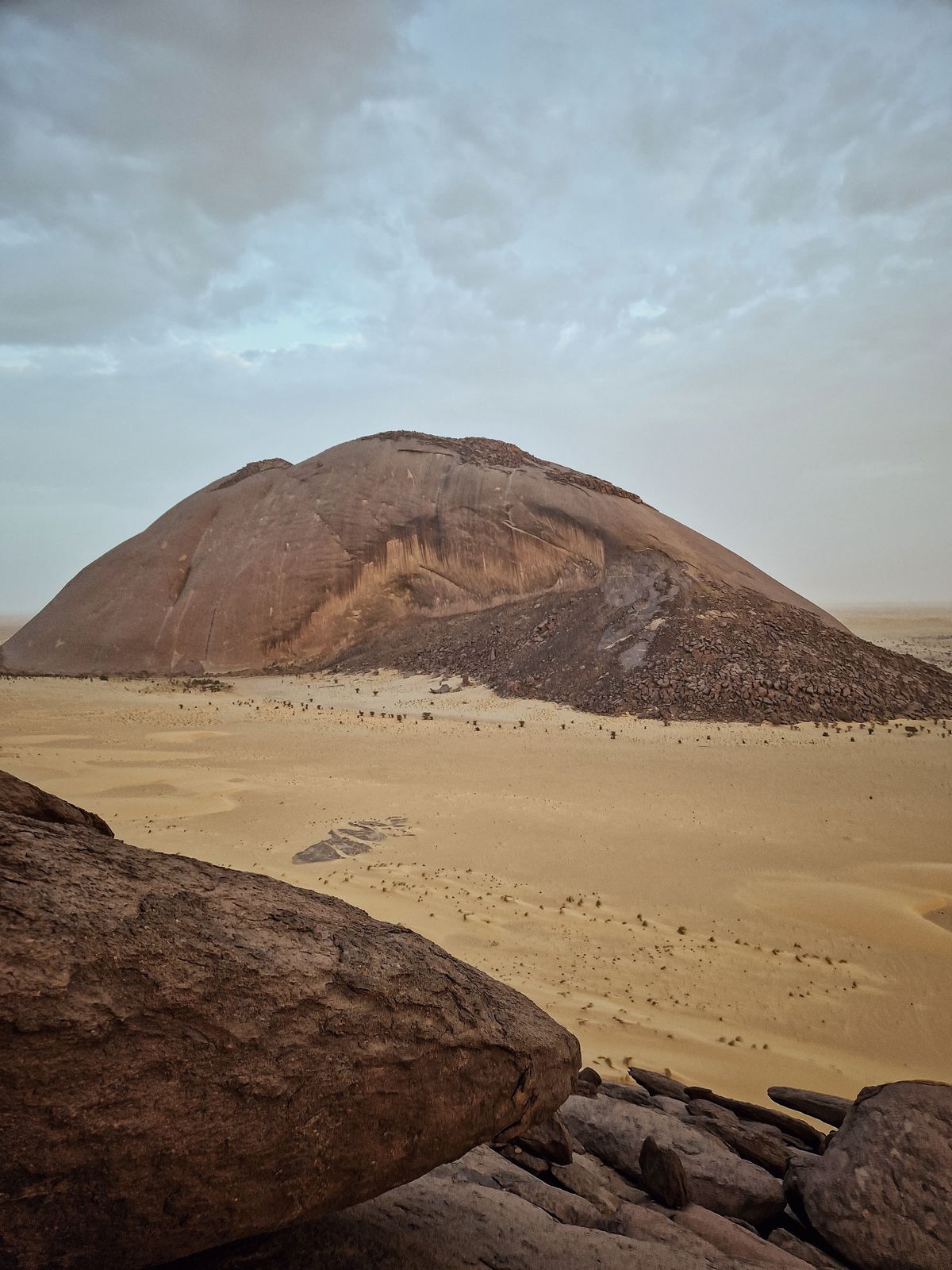
- The desert landscape around Choum — stark, mineral, and completely empty in every direction
- The stars at night — no light pollution, no ambient glow, just the Milky Way at full intensity
- The sense of remoteness — Choum is one of the most isolated places accessible by wheeled vehicle in West Africa
- The transition from 4x4 desert travel to rail — changing modes of transport in the middle of the Sahara
Best Time to Visit Choum
October through March, aligned with the Iron Ore Train experience overall. The key constraint at Choum is not the temperature so much as the waiting — you may arrive and need to wait several hours for the train, which can be brutal in summer heat with no shade and temperatures exceeding 45°C.
November through February is by far the most manageable period. Daytime temperatures at Choum in this window range from 20°C to 35°C depending on the month, and nights can be genuinely cold (down to 8–12°C). A warm layer is essential for the night journey on the train — the open wagons channel a powerful wind at the train's speed, and the temperature drops further as you move.
March and October are borderline — the days are increasingly hot, but the nights are still manageable. Anyone planning to ride the open ore wagons rather than the passenger carriage should avoid April through September entirely.
Getting to Choum
Choum is reached from Atar by 4x4 across an open desert piste of approximately 180–200 kilometres, depending on the route taken. In good conditions with an experienced driver, this takes four to five hours. The route crosses the Adrar plateau and descends into the lower desert, passing through dramatic and largely empty terrain.
There is no paved road to Choum, no bus service, and no reliable shared transport. The 4x4 route from Atar is the standard approach for most travellers, arranged as part of an Adrar desert tour. Some travellers approach from the south or west via other desert routes — possible but requiring even more specialist navigation.
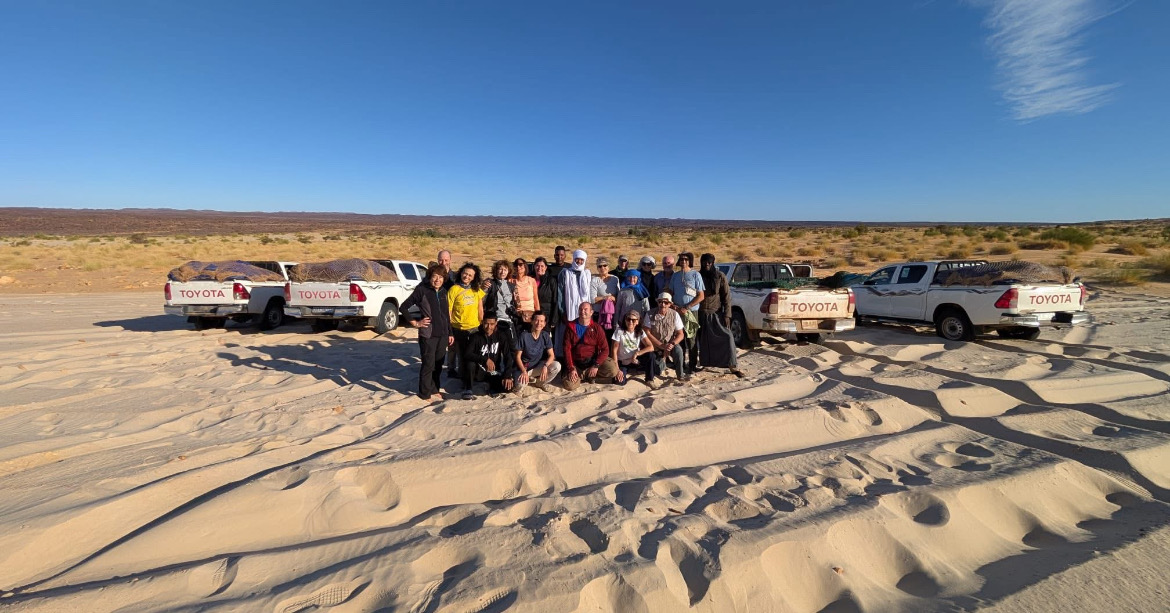
Arriving at Choum, the key challenge is timing the train. The train has no fixed public timetable — it runs according to SNIM's operational requirements, typically once or twice daily from Zouerate. The exact time it reaches Choum can vary by several hours. Local knowledge — either from residents at Choum or from Zouerate via phone — is the only reliable way to plan your boarding. This is precisely why having a local guide who knows the people at Choum is so valuable.
See also: Iron Ore Train complete guide →
What to Expect in Choum
Expect nothing — and then be surprised by something. Choum is stripped to essentials: a few buildings, a mosque, the rail line, and the desert. There is no accommodation for tourists, no food available beyond what local families might share, no water point you can rely on, and no mobile signal much of the time.
You wait. This is the defining experience of Choum. You arrive, you find the best shade available, you drink your water slowly, you talk to whoever is there, and you wait for the train. When it comes, it arrives with a low vibration felt in the ground before you hear it — a sound that builds slowly across the flat desert before the first locomotive appears.
The scale of the train is the first shock. Stretching back two to three kilometres, it is an industrial object on a scale that nothing in the environment around Choum prepares you for. The boarding — jumping wagons that are moving slowly, finding your place in the iron ore dust — is the defining logistical challenge of the Iron Ore Train experience, and the reason why local help at this moment is not optional.
Travel Tips for Choum
- 1.Bring 4+ litres of water per person — you may wait hours at Choum before the train arrives
- 2.Pack all supplies for the train journey before reaching Choum — there is nothing to buy here
- 3.Confirm the train's approximate timing before leaving Atar — your guide's contacts in Choum or Zouerate can help
- 4.Dress in layers: desert daytime heat plus night train wind are two entirely different conditions
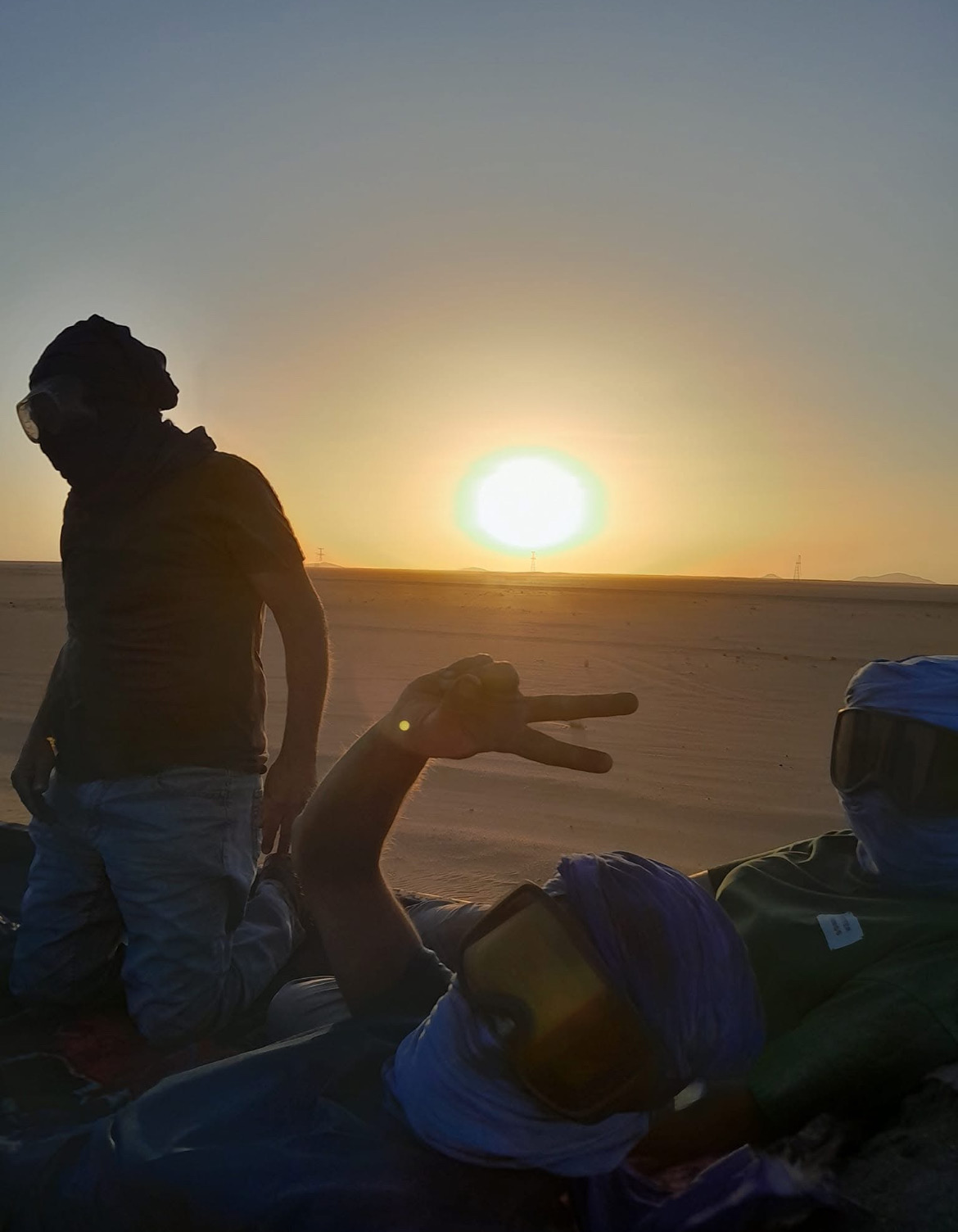
- 5.Bring a full set of dust protection for the train: goggles, bandana or dust mask, sealed bags for electronics
- 6.A head torch is essential for boarding and navigating the wagons in darkness
- 7.Coordinate with your guide about the pick-up from Nouadhibou after the journey ends
With Mauritania Experience
How We Handle Choum
Choum is the operational centrepiece of our Iron Ore Train tours. We manage all the logistics that make Choum viable: the 4x4 transport from Atar, the local contacts who can track the train's approximate timing, the guidance at the boarding moment, and the coordination of your arrival in Nouadhibou at the other end.
The boarding at Choum is not something we can make entirely predictable — the train runs on its own schedule, and the desert has a logic of its own. What we can ensure is that you arrive prepared, wait in the safest possible conditions, and board the train with confidence rather than confusion.
If you are planning the Iron Ore Train experience, Choum is where it becomes real. Everything else — the research, the packing, the desert drive — leads to this moment on the tracks.
Explore More