Richat Structure
The Eye of the Sahara — one of Africa's greatest geological wonders
Overview
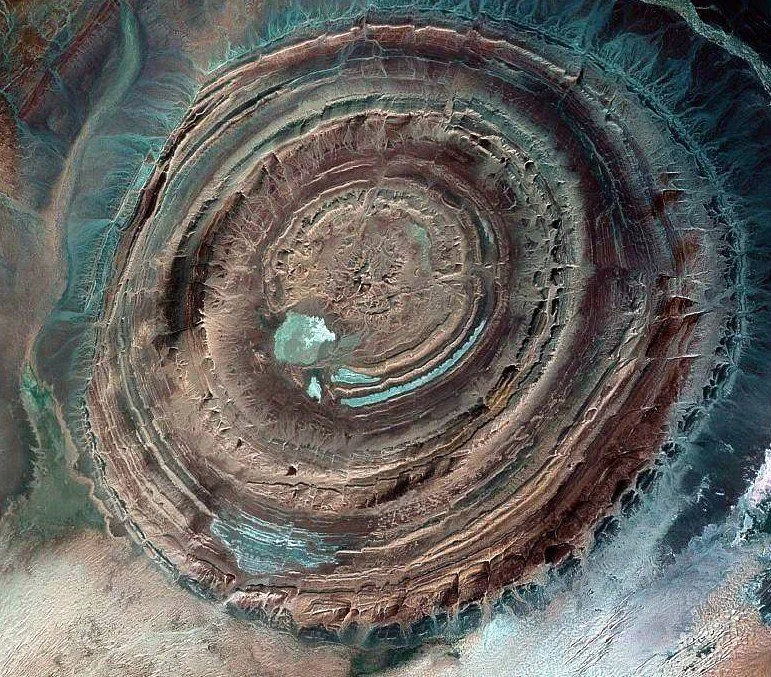
From orbit, it looks like a giant bull's-eye drawn into the Sahara — a perfectly symmetrical series of concentric rings spanning 50 kilometres across the open desert of the Adrar plateau. The Richat Structure, also known as the Guelb er Richât or simply the Eye of the Sahara, is one of the most visually striking geological formations on the planet, and one of the first landmarks that astronauts aboard the International Space Station learn to identify below them.
On the ground, the experience is different from the satellite images — and arguably more powerful. You stand among ancient eroded rock, wind-carved stone ridges, and open desert that stretches in every direction. The scale is humbling. The scale of the structure means it reveals itself slowly, through the curvature of the rings and the way the terrain constantly shifts around you as you move through it.
The Richat Structure sits roughly 40 kilometres west of Ouadane in the Adrar region, making it a natural companion destination for anyone visiting the ancient cities of Chinguetti and Ouadane. It is not a tourist attraction in any managed sense — no visitor centre, no entrance fee, no infrastructure of any kind. It is simply one of the Earth's great wonders, sitting in the open Sahara, accessible only to those willing to cross the desert to reach it.
Continue planning: Photography in Mauritania
Formation: Not a Crater, but a Dome
For decades after its discovery, scientists debated whether the Richat Structure was caused by a meteorite impact — the circular symmetry seemed too perfect to be natural. Subsequent geological analysis disproved the impact theory: the structure shows none of the shock metamorphism or impact-related features expected from a meteorite crater.
The current scientific consensus is that the Richat Structure is an uplifted geological dome — a section of the Earth's crust that bulged upward, then was worn down over millions of years by erosion. The resistant rock layers eroded at different rates, creating the concentric ring appearance visible from space. The outermost rings are Proterozoic quartzite; the interior contains younger volcanic and sedimentary rocks. The age of the dome is estimated at roughly 500–600 million years.
Geologists have found evidence of ancient volcanic intrusions, hydrothermal activity, and large-scale rock deformation within the structure. The centre of the dome contains kimberlite — the rock associated with diamond pipes — though no economically significant deposits have been found. The entire structure represents one of the most accessible and visually dramatic examples of dome erosion geology anywhere in the world.
Highlights of Richat Structure
- Standing on the outer ring ridgeline for a sweeping view across the concentric desert terrain
- Photography of the ancient quartzite rock formations — otherworldly textures and colours
- Evidence of ancient human presence: stone tools and remnants found within the structure
- The silence — the interior of the Eye of the Sahara is one of the quietest places on Earth
- Stargazing from within the structure at night — zero light pollution, unlimited sky
- The approach drive across the open Adrar plateau — a landscape unlike anywhere else in Africa
- Combining with nearby Ouadane for a half-day of geological exploration followed by medieval history
Best Time to Visit the Richat Structure
October through March is the only viable period. The Richat Structure sits on an open, exposed plateau with no shade and no water. In summer, temperatures inside the structure reach 45–50°C and the experience is genuinely dangerous. Even in spring (March–April), midday heat is severe.
November through February is optimal — clear skies, temperatures in the 25–35°C range during the day, and cold nights that make camping comfortable. The quality of desert light in this period is exceptional, particularly in the early morning and late afternoon when the rocky ridges cast long shadows and the colour of the stone shifts from grey to orange to deep red.
For drone photography or elevated viewpoint photography, morning is preferable — the air is clearer before the afternoon heat haze builds. Overnight camping within or near the structure is one of the great desert experiences in Mauritania, and only possible in the cooler months.
Getting to the Richat Structure
The Richat Structure is reached from Atar via a desert piste of approximately 120–130 kilometres, typically passing through or near Ouadane. The exact route varies depending on conditions and which part of the structure you want to approach from — the western rim, the central basin, or the elevated viewpoints on the northern ring.
There is no road, no signage, and no infrastructure of any kind. The entire approach is open desert navigation, requiring a proper 4x4, an experienced desert driver, and a working GPS backed by local knowledge. Without these, finding the structure is genuinely difficult, and getting stuck in the desert here is a serious situation.
Practically, the Richat Structure is visited as part of a multi-day Adrar desert expedition based out of Atar. It works naturally as part of a Ouadane loop — spending one or two nights in the Ouadane area and making the Richat Structure a half-day excursion from there. We design logistics around this approach and can advise on the best entry point depending on your specific interests.
What to Expect at the Richat Structure
No entrance gate, no visitor centre, no guide office, no souvenir stand. Just the desert and the rocks. This is the genuine, unmediated Sahara. You should be prepared for a raw wilderness experience rather than a managed heritage site.
The scale of the structure is disorienting in the best way. The outermost ring spans 50 kilometres in diameter, which means you can drive through sections of it without immediately grasping that you are inside the structure at all. Elevated viewpoints on the outer ridges reveal the concentric pattern most clearly. A drone, if you have one, transforms the visual experience.
Bring substantial water (3–4 litres per person minimum for a day visit), sun protection, and food. There is nothing to buy and no shade except what your vehicle provides. Your driver will be an essential part of the experience — a good local driver knows which ridge offers the best views and can navigate within the structure safely.
Travel Tips for Richat Structure
- 1.Bring a drone if possible — aerial photos reveal the concentric ring structure dramatically
- 2.Carry 3–4 litres of water per person for a day visit; more for overnight
- 3.No infrastructure exists — bring all food, supplies, and navigation equipment
- 4.An experienced 4x4 driver who knows the area is non-negotiable here
- 5.Elevated viewpoints on the northern rim give the best ground-level perspective of the rings
- 6.Overnight camping inside the structure for stargazing is possible with the right support
- 7.Combine with Ouadane (nearby) for a two-day geological and historical desert excursion
With Mauritania Experience
How We Visit the Richat Structure
We include the Richat Structure as part of our extended Adrar desert tours, typically as a half-day or full-day excursion from an Ouadane base. Our drivers know the most rewarding approach routes and the elevated viewpoints that give the clearest perspective on the structure's scale.
For travellers with specific interests in geology, photography, or astronomy, we can design dedicated expeditions to the Richat Structure — including overnight camping on the outer rim for night photography and stargazing. The combination of zero light pollution, the alien landscape, and a clear Saharan sky makes for one of the most extraordinary night experiences in Africa.
If you are planning an Adrar desert expedition and want to include the Richat Structure, contact us or book through our website and mention this destination specifically. We will build the most logical routing.
Explore More
Related Destinations
Also Consider
The Iron Ore Train Experience
Combine Richat Structure with the legendary Iron Ore Train — 700 km across the Sahara from Choum to Nouadhibou. Many travellers include both on the classic Mauritanian circuit.
Iron Ore Train Guide