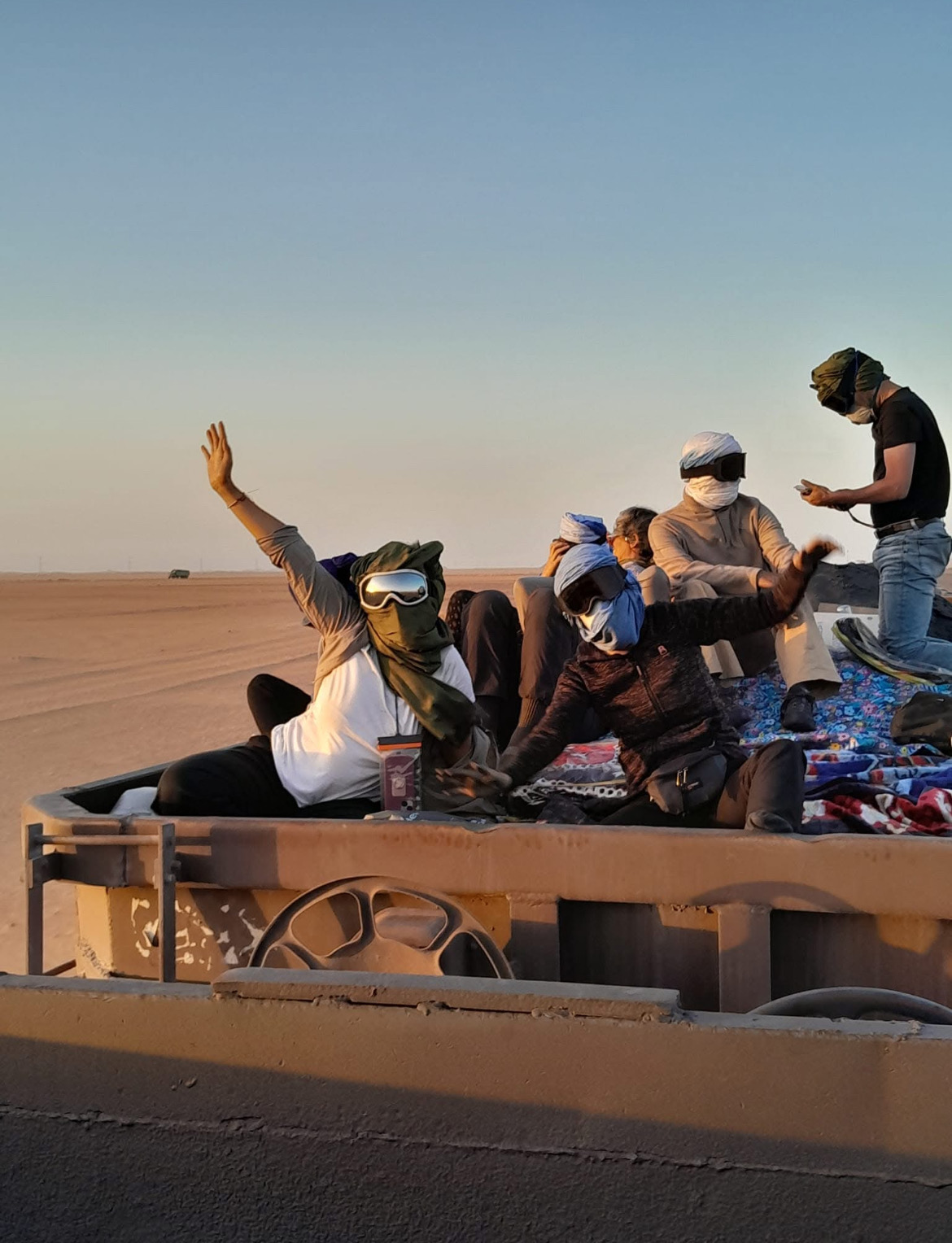
Choum: The Iron Ore Train Boarding Point — What to Expect
Choum is not a destination. It is a moment — the point where 180km of desert driving converges with an unpublished train timetable and produces one of the most extraordinary boarding experiences in world travel.
What Choum Actually Is
Choum is a small desert settlement that exists because of the railway. Without the Iron Ore Train line running through it, there would be no reason for Choum to exist — no water source, no agricultural land, no natural resource, no strategic crossroads. There is the rail line, the people who work it and live near it, and the train that passes through.
The population numbers several hundred — SNIM rail workers, their families, and a small number of people who provide services to the community and to passing travelers. There is no tourist infrastructure: no hotel, no restaurant serving tourists, no visitor centre, no train schedule posted anywhere. The information and services that make the Iron Ore Train experience work at Choum come from local relationships, not formal systems.
Set your expectations accordingly. Choum is not a place you visit. It is a place you pass through at the moment the train passes through — and that moment is extraordinary. Arrange your complete Choum and Iron Ore Train itinerary in advance at mauritaniaexperience.com/book.
Getting From Atar to Choum
The standard route to Choum for travelers on the Adrar circuit is by 4x4 from Atar or from Chinguetti, depending on your itinerary. The distance from Atar is approximately 180–200km by desert piste — a 4–5 hour drive through open Adrar desert that progressively shifts from rocky plateau into flatter terrain.
The piste from Atar toward Choum does not follow a single marked route. It is a desert track that experienced local drivers navigate by landmarks — specific rock formations, the remnants of old wells, the behavior of the terrain that tells a practiced eye which direction continues. GPS tracks exist but are not always current. A driver who has made this journey many times is navigating from knowledge, not from maps.
The drive itself deserves a slow pace if your schedule allows — the landscape between the Adrar plateau and Choum moves through several geological zones that are visually distinctive and tell the story of the desert's formation. Stop when something interests you. The schedule flexibility that makes the train wait manageable also makes the journey something more than transit.
Tracking the Train: No Published Timetable
The Iron Ore Train has no published passenger timetable. SNIM operates it on a mining schedule driven by production requirements at Zouerate and the export loading schedule at Nouadhibou — neither of which is disclosed publicly or organised around passenger convenience.
In practice, trains pass Choum roughly once or twice in a 24-hour period. The timing varies significantly from day to day. Without local contacts, the most specific estimate you can form is 'sometime today or tonight.'
With local contacts — specifically your guide's network of SNIM workers at Zouerate or contacts at Choum who watch the train pass regularly — this uncertainty narrows considerably. A good guide can give you a 4–6 hour window of probable arrival, which is enough to plan your wait, your meals, and your rest.
This is the specific value of working with an experienced local operator on the Iron Ore Train trip. Train timing intelligence is not accessible to travelers without the right local relationships.
Making the Wait at Choum Work For You
The wait at Choum is not something to manage or minimize. It is part of the experience — and travelers who arrive already frustrated about the wait are in the wrong frame of mind for what follows.
What the wait provides: time to settle into the desert pace. Time to have conversations with SNIM workers who move through — men who make this train crossing regularly and who carry an entirely different relationship with the desert than anyone who drives to Choum from Atar once in their life. Time to let the landscape work on you — the flat desert, the rail lines disappearing toward two horizons, the silence so complete that a moving camel is audible at 3km by the sound of its bells.
Bring everything you need for comfort: 3–4 litres of water per person, all your food for the journey, something to sit on, shade from the vehicle, and the patience that the desert rewards with experiences no scheduled travel can manufacture.
When the Train Arrives
The first sign of the train is not sound but ground vibration — a subtle tremor felt through the soles of your feet that begins several minutes before the locomotive becomes visible on the horizon. The sound builds slowly from the northeast, too low and sustained to be anything except something very large moving across the desert.
Then the first locomotive appears — a dark shape that resolves into detail as it closes the distance. The scale of the train becomes apparent only gradually: 2–3 kilometres of wagons, multiple locomotives, a sustained industrial roar that is enormous in a landscape that has been silent for hours.
This moment — the train arriving across the Mauritanian desert, at exactly the point you have been driving toward and waiting for — is genuinely among the most striking things available to any traveler anywhere. Experience it fully before your attention shifts to boarding logistics.
The Boarding Moment
The train slows significantly at Choum but may not stop completely. Boarding happens at low speed — this is the critical operational window. Your guide's contacts at Choum know exactly where to position you relative to the track, which wagon type to target, and which people to coordinate with.
Boarding a moving train with luggage requires physical coordination and confidence. Jump at the right moment, grip the wagon ladder or edge with both hands, and clear the edge immediately. The local SNIM workers who board at Choum do this routinely — watch how they move and match their timing.
This is the point where local knowledge changes the safety calculation most significantly. A traveler who arrives at Choum without contacts and without a guide, attempting to board at the wrong position with heavy luggage, faces a genuinely higher risk than one who boards with guidance. This is not fearmongering — it is the practical reality of boarding a working freight train in a remote desert location.
Westbound vs. Eastbound: Which Direction
The westbound train — from Zouerate to Nouadhibou — is the tourist direction. The wagons on the westbound run are empty (returning to Zouerate to be loaded), which means far less iron ore dust than a loaded train and the dramatic open-wagon experience that travelers come for.
The eastbound train — from Nouadhibou to Zouerate — carries a full load of iron ore. The dust exposure in open wagons on a loaded train is dramatically higher than on the empty westbound run. The destination (Zouerate, a mining town with no tourist infrastructure) also lacks the dramatic Atlantic arrival that Nouadhibou provides.
For virtually all travelers, the westbound direction from Choum to Nouadhibou is the right choice. Some experienced adventurers do the eastbound journey specifically for the contrast and dust intensity — but this is a very small minority, and it requires specific logistics at Zouerate that most travelers don't have arranged.
Frequently Asked Questions
How long will I wait for the train at Choum?
Without local timing information: potentially the full day. With a guide who has SNIM contacts: a 4-6 hour window, typically narrowing to 2-3 hours of actual wait. Build for the longer scenario and hope for the shorter.
Is there anywhere to sleep in Choum?
No accommodation exists for tourists in Choum. You sleep in your 4x4 or in the open. This is why your vehicle is not just transport to Choum — it is your shelter while you wait.
Can I board the Iron Ore Train in Zouerate instead of Choum?
Yes. Zouerate is the official eastern terminus where the train originates. The full journey from Zouerate to Nouadhibou is 704km and 14-20 hours. Choum is preferred by most travelers because it fits naturally into the Atar/Adrar circuit and the 8-12h Choum→Nouadhibou journey is more manageable than the full run.
Plan Your Adventure
Book Your Mauritania Tour
We handle every detail — 4×4 transport with experienced local drivers, the Iron Ore Train boarding at Choum, ancient desert cities, and the guides who open the right doors. Tell us your dates and we'll build the right trip around you.
- Iron Ore Train experience from Choum
- Chinguetti, Ouadane & the Richat Structure
- Terjit Oasis & full Adrar desert circuit
- Banc d'Arguin, Nouadhibou & the Atlantic coast
Keep Reading