The Iron Ore Train at Night: What Actually Happens After Dark
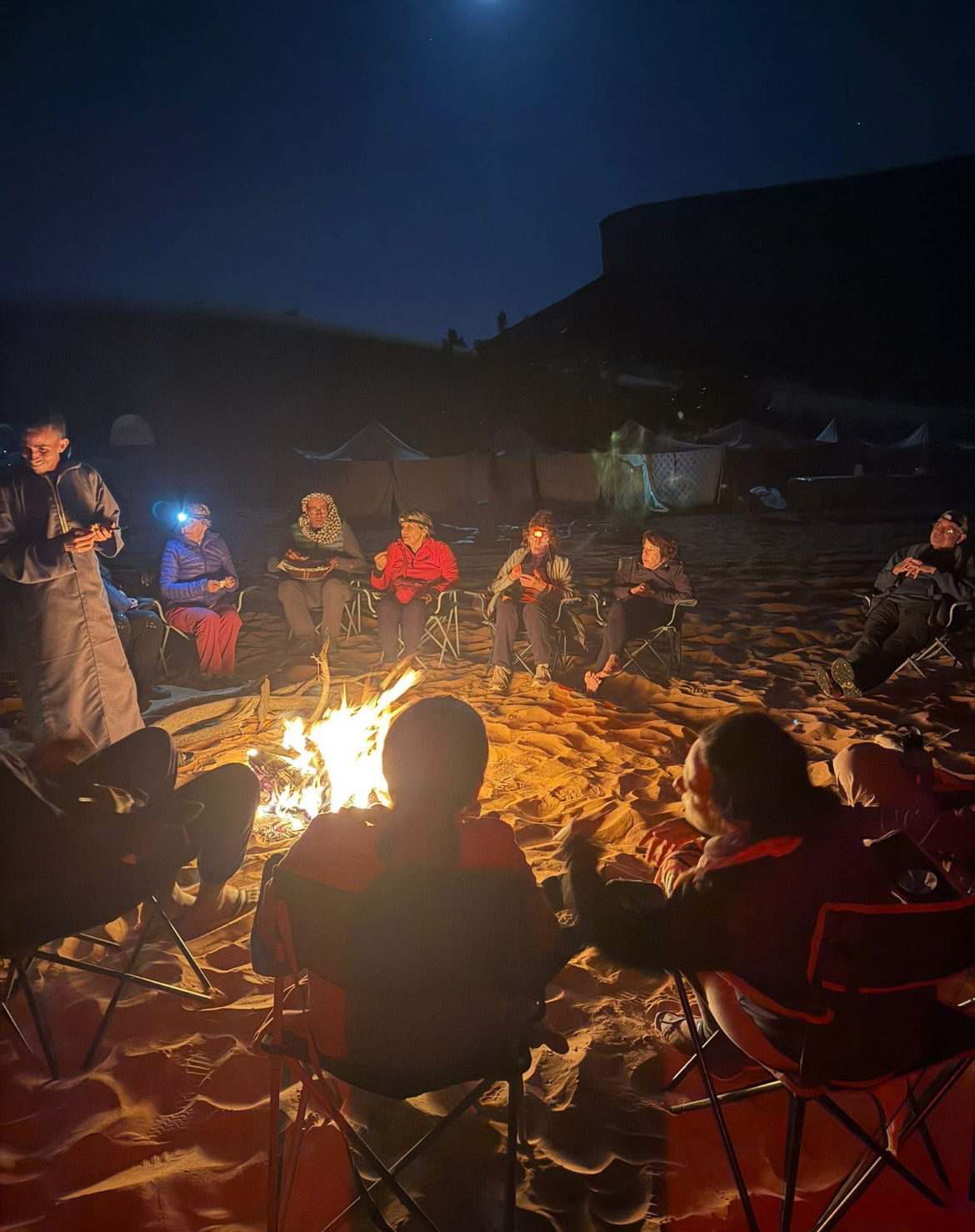
The night portion of the Iron Ore Train crossing is the part that travelers talk about longest. The temperature drops, the dust settles slightly, and the Saharan sky opens up above you in a way that changes your relationship with darkness permanently.
Why the Night Portion Defines the Experience
Travelers who board the Iron Ore Train at Choum in the late afternoon — the most common scenario — spend 6-8 hours in darkness before the first light of dawn appears over the Atlantic. This is not a footnote to the journey. It is the journey.
The daytime desert view from the wagon is spectacular: flat red earth, distant plateaux, the occasional acacia tree surviving against all logic, a sense of scale that only truly empty land conveys. But the night portion is what changes people. The moment the last trace of natural light fades and the Milky Way becomes clearly visible overhead is reported consistently by travelers as one of the most powerful experiences of their lives.
Prepare for the night deliberately. Travelers who arrive without adequate sleeping gear are miserable. Those who arrive with proper layers, enough food and water for a long dark journey, and realistic expectations describe this crossing for decades afterward. If you want to experience it fully prepared, our booking page walks you through what to arrange before you board.
The Temperature Reality After Dark
The Sahara at night is cold, not warm. This catches many first-time travelers off guard — their mental model of a desert involves warm sand and balmy nights. The Saharan desert sheds heat rapidly after sunset; dry air retains none of the warmth that humidity holds in tropical climates.
In November, the ambient temperature in the western Saharan desert drops to 10-14°C after midnight. Standing in a field, this is manageable. In a steel wagon moving at 40-50km/h, wind chill brings the effective temperature close to 0°C. In December and January, ambient readings below 8°C combined with train wind can produce genuinely dangerous cold for under-prepared travelers.
Iron ore dust coating your skin and clothing also accelerates evaporative cooling — you lose body heat faster than you would under clean, dry conditions. A sleeping bag is not optional for the night crossing. A windproof outer layer over thermal base layers is not optional. Gloves and a warm hat are not optional. Travelers who dismiss these as optional in the warmth of Atar deeply regret it in the iron wagon at 2am.
The Sky: Why Travelers Come Back for This
Mauritania has essentially zero light pollution across its interior. The western Sahara between Choum and Nouadhibou contains no significant settlements, no highways, no agricultural lighting — nothing to dilute the darkness. On a clear night — which the Mauritanian desert delivers reliably from October through March — the result is one of the most spectacular night skies accessible anywhere on Earth without technical equipment.
The Milky Way appears as a structural feature of the sky: not a faint smear at the horizon's edge but a dense, three-dimensional band of light running from one horizon to the other. Individual star clusters resolve without binoculars. Shooting stars are frequent. When planets are above the horizon, they are bright enough to cast faint shadows.
For travelers from northern hemisphere cities, this sky is genuinely unfamiliar — not in a different hemisphere exactly, but at a latitude and under conditions that reveal stars never visible through urban light pollution at home. Photographers who want astrophotography from a truly unique angle — shot from inside an iron ore wagon, the wagon walls as foreground, the Milky Way overhead — have access to a composition that almost no one has taken.
Sleeping in a Moving Iron Wagon
Many travelers sleep more than they expect on the night portion of the Iron Ore Train. The rhythm of the train on the tracks, combined with exhaustion from the Choum wait and the day's travel, produces surprisingly sound sleep once you are properly warm.
Positioning is the key. Curl against the wall of the wagon to block the sustained airstream from the train's movement — direct wind exposure while travelling at speed is dramatically colder than standing still. Your sleeping bag should be fully zipped with the hood cinched around your face, mask and goggles still in place.
Use your main bag as a pillow and arrange your daypack as a windbreak. Other travelers in the wagon — SNIM workers who make this run regularly — will settle into positions that work; watch where they choose to lie. Waking typically happens around dawn, prompted by the gradually brightening sky and the first smell of the Atlantic approaching Nouadhibou. That moment is worth staying alert for.
The Dawn Arrival in Nouadhibou
The approach to Nouadhibou announces itself first as a lightening of the eastern sky, then a gradual shift in the landscape — flat desert giving way to more coastal terrain, and the first human lights visible at the city's industrial fringe.
The smell arrives before the city does. The Atlantic Ocean, after 10-12 hours of pure desert air, is unmistakable — salt, sea, and a humidity the desert entirely lacks. Travelers consistently name this moment — the scent of the ocean closing in while the train still rolls — as one of the most memorable of the entire crossing.
The arrival at the SNIM terminal is industrial rather than scenic; this is a working freight operation, not a passenger station. Your guide or operator should have arranged a pickup from the terminal — confirm this before boarding at Choum. Arriving in an unfamiliar industrial terminal at dawn with no transport waiting is a significantly worse experience than anything the train itself delivers.
Frequently Asked Questions
Is it safe to sleep in open wagons at night?
With proper preparation — sleeping bag, layers, mask, goggles, and positioning against the wagon wall — yes. The risks are cold exposure (mitigated by gear) and disorientation if you wake and wander from the wagon (mitigate by staying in your settled position).
How cold does the Iron Ore Train get at night?
In November, effective temperature in the wagon at night is approximately 5-8°C with wind chill. In December-January, this can approach 0°C or below. A sleeping bag rated to at least 5°C is minimum; 0°C or lower for winter months.
Can you actually see the Milky Way from the train?
Yes — clearly, in full structure, running horizon to horizon. The western Saharan desert has essentially zero light pollution, and clear nights are the norm from October through March. This is consistently cited as the most powerful single moment of the journey.
Plan Your Adventure
Book Your Mauritania Tour
We handle every detail — 4×4 transport with experienced local drivers, the Iron Ore Train boarding at Choum, ancient desert cities, and the guides who open the right doors. Tell us your dates and we'll build the right trip around you.
- Iron Ore Train experience from Choum
- Chinguetti, Ouadane & the Richat Structure
- Terjit Oasis & full Adrar desert circuit
- Banc d'Arguin, Nouadhibou & the Atlantic coast
Keep Reading