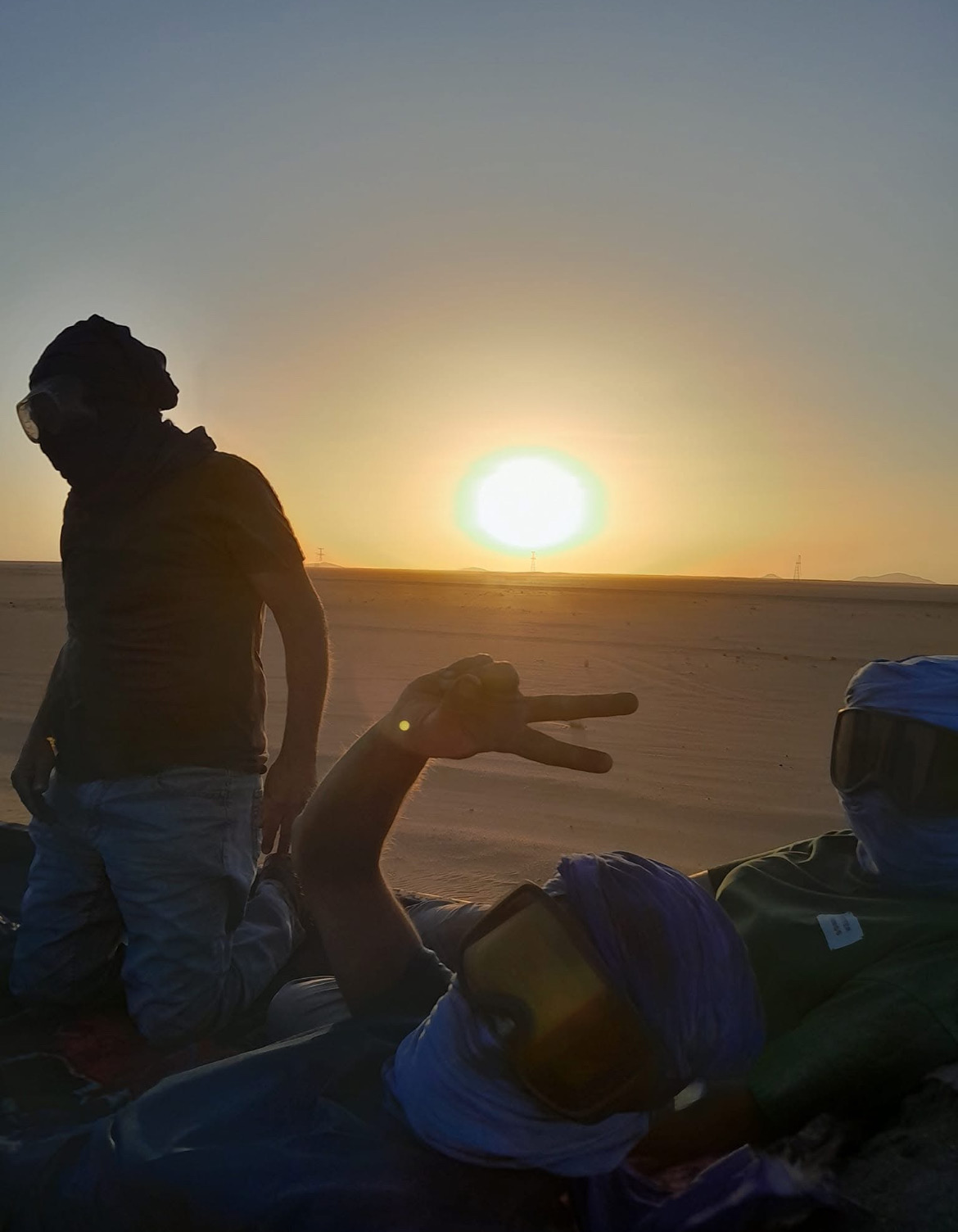
Mauritania Iron Ore Train Guide
The Mauritania Iron Ore Train is one of the world's longest and most remote train journeys — 704 kilometres across the Sahara, iron ore dust, and a desert sky that few travellers ever see. This guide covers everything: route, boarding point, wagons versus carriage, the schedule, packing, safety, best months, reaching Choum, and what to do in Nouadhibou.
Mauritania Experience
Arrange Your Iron Ore Train Experience
Mauritania Experience is a local operator based in Mauritania. We organise complete Iron Ore Train expeditions — 4×4 transport from Nouakchott or Atar, the full Adrar desert circuit through Chinguetti, transfer to Choum for boarding, and all logistics through to Nouadhibou. You focus on the experience; we handle everything else. Questions welcome on WhatsApp before you commit to anything.
The Route: Zouérat, Choum, and Nouadhibou
The Iron Ore Train runs between Zouérat — a remote mining city in the far north of Mauritania — and Nouadhibou, the country's main Atlantic port. The full route covers 704 kilometres, making it one of the longest train journeys in Africa.
The railway is operated by SNIM (Société Nationale Industrielle et Minière), Mauritania's state mining company. Its purpose is industrial: loaded trains carry iron ore from the mines near Zouérat west to the port at Nouadhibou for export. Returning empty trains head east. Passengers — in the open ore wagons or the rear passenger carriage — travel at the railway's convenience, not their own.
The main stops along the route are Zouérat in the northeast, Tmeimichat roughly mid-route, Choum (where most travellers board), and then the long final run through open desert to Nouadhibou. Between Choum and Nouadhibou — approximately 460 kilometres — there are no visible towns, no roads, and no infrastructure of any kind. Flat Saharan gravel plain, iron ore dust, and an immense sky.
If you want to join an organized expedition, you can book a locally organized Mauritania Iron Ore Train tour — we handle transport, guides, Choum boarding, and all desert logistics.
Where Travellers Normally Board
Most travellers board at Choum. It sits at the natural end of the classic Adrar desert circuit — Nouakchott to Atar to Chinguetti to Choum — making it the practical starting point for the vast majority of visitors who include the Iron Ore Train as part of a wider Mauritania itinerary.
Boarding at Zouérat gives you the full 704-kilometre run but adds a two-day drive each way through very remote terrain in the Tiris Zemmour region. For experienced desert travellers who want the complete journey, it is a legitimate option. For most first-time visitors to Mauritania, Choum is the right decision.
Boarding at Tmeimichat is occasionally mentioned but rarely practical. It is a featureless waypoint with no accommodation, and timing a vehicle arrival to coincide with the train is significantly more difficult than at Choum.
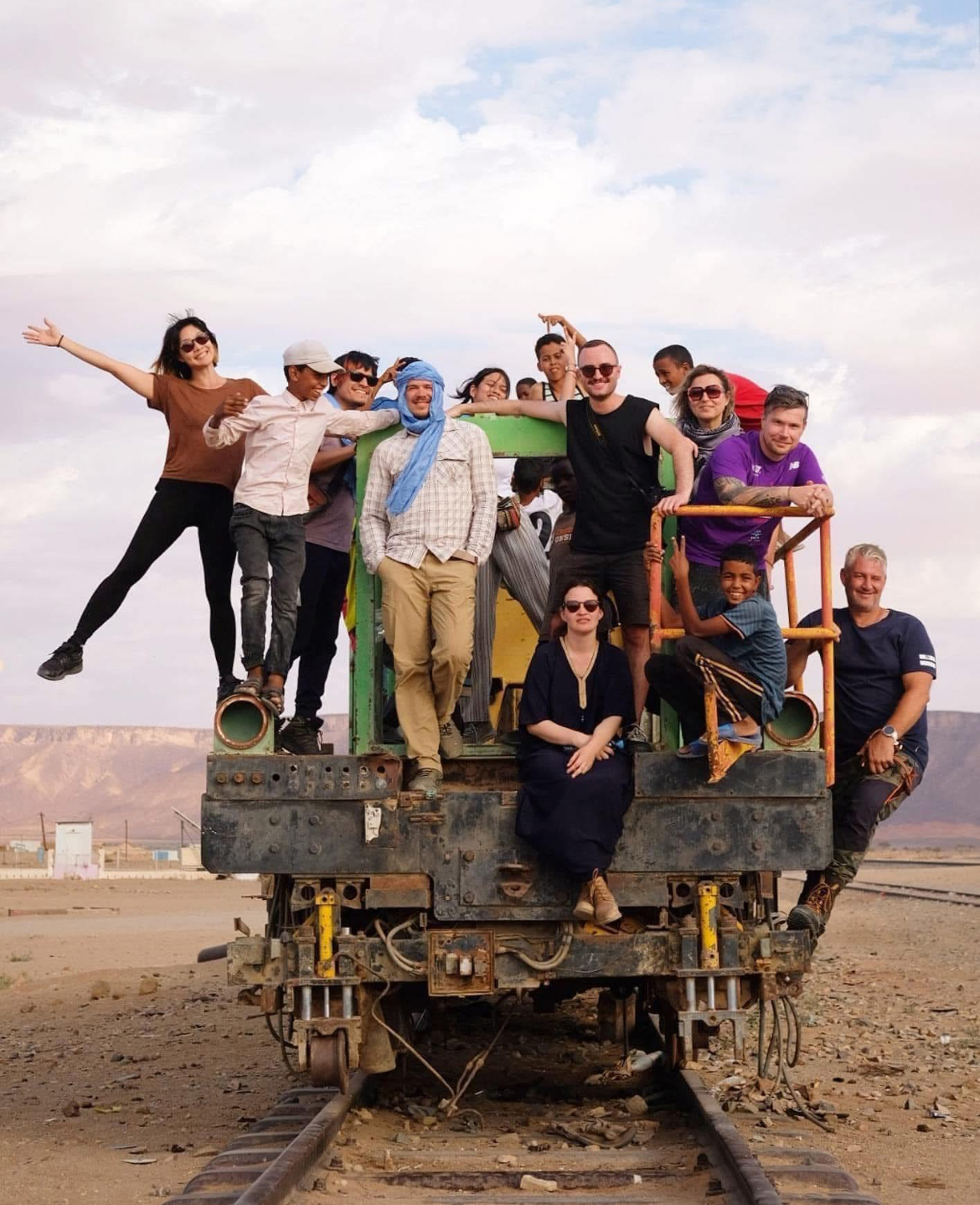
Iron Ore Wagons Versus the Passenger Carriage
Every Iron Ore Train has a passenger carriage attached to the rear. Travellers choose between this carriage or the open iron ore wagons — and the choice defines the experience.
The open wagons are free on the westbound (empty) run from Zouérat or Choum to Nouadhibou. They have no roof, no seats, and no protection from wind or dust. You sit or lie on iron ore residue coating the wagon floor — everything you carry will be covered in dark red-black dust by journey's end. The experience in return is extraordinary: the scale of the open desert, the train snaking through a flat landscape, the night sky over the Sahara from inside a slowly moving steel box. These are moments that stay with travellers permanently.
The passenger carriage costs between 2,000 and 5,000 MRU per person (roughly €5–12), negotiated at the station. It has benches and partial shelter from the wind. Iron ore dust still reaches it. It is considerably less dramatic than the wagons but a sensible option for travellers with dust-related health concerns, those with young children, or anyone who prefers the journey with reduced physical exposure.
Neither option is conventionally comfortable. The carriage is a practical choice. The wagons are the real Iron Ore Train experience.
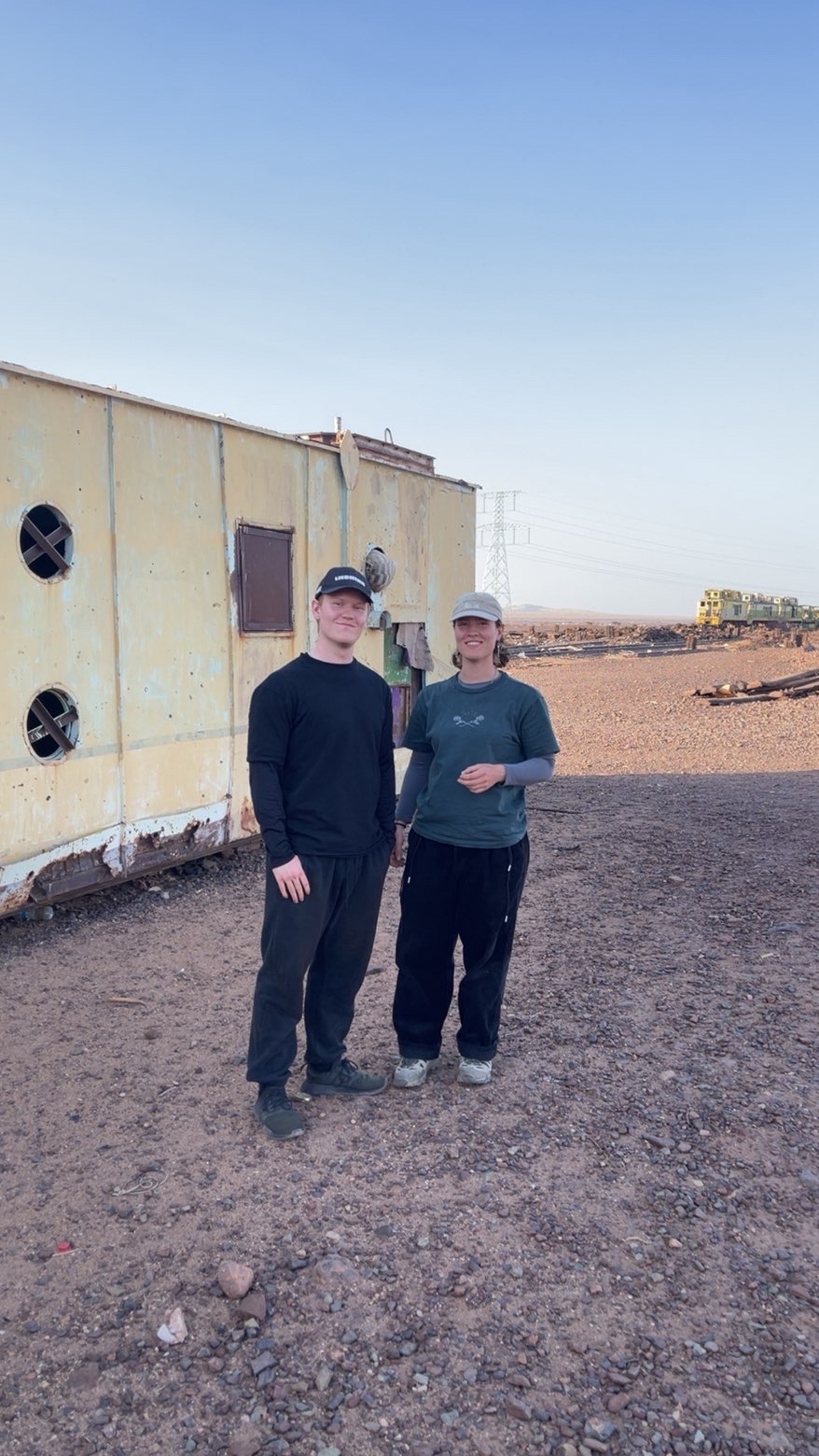
Why the Train Schedule Is Not Fixed
There is no public timetable for the Iron Ore Train. SNIM runs it on a mining schedule that changes daily according to operational requirements — ore loading volumes, maintenance windows, and port logistics at Nouadhibou. Departures from Zouérat are broadly in the early morning or late afternoon but shift, sometimes significantly, from day to day.
This means you cannot plan to arrive at Choum on a specific day and board within a few hours. Travellers using a local operator will typically have a contact monitoring the train's expected arrival window — local contacts near the station often have advance notice of when the train left Zouérat, which gives a rough estimate of when it will reach Choum.
Budget two nights near Choum rather than planning to arrive and board the same day. The wait is part of the Iron Ore Train experience. Choum itself — the edge of the open desert, the silence, the local rhythm — is worth a night in its own right.
Approximate Journey Duration
From Choum to Nouadhibou, the journey typically takes 8 to 12 hours. The full run from Zouérat covers 704 kilometres and takes 14 to 20 hours, depending on loading stops, maintenance halts, and the operational pace on that particular day.
These are realistic estimates rather than guaranteed windows. The train does not run to a schedule, and delays of several hours occur. A journey beginning at Choum in the afternoon may arrive in Nouadhibou at dawn, at midnight, or at midday the next day. The night portion — typically 4 to 8 hours regardless of departure time — will be cold in the open wagons even in October and November.
When planning onward connections from Nouadhibou, budget for the longer end of the duration range. Do not book non-refundable transport for the day immediately after your expected arrival.
What to Wear and Pack
The Iron Ore Train has no facilities on board — no food, no water, no toilets, no shelter in the wagons. Everything you need for the journey must be sourced in Atar or Choum before boarding.
Read the full Iron Ore Train packing list for a detailed breakdown of every item, why it matters, and what to buy before you leave.
- FFP2 or N95 dust mask — bring 2 to 3 per person; fabric bandanas do not filter iron ore particulate
- Wraparound goggles or sealed sunglasses — iron ore dust in unprotected eyes is painful within minutes
- Sleeping bag rated to at least 5°C — even October nights in an open wagon with wind chill are genuinely cold
- Windproof outer jacket — wind in the open wagons is constant and cuts through light layers
- Thermal base layer for the night portion of the journey
- Minimum 3 to 4 litres of water per person — nothing is available on board
- Food for the full journey: fresh bread, dates, tinned fish with pull-ring opening, nuts, dried fruit
- Head torch for night boarding and navigating the wagons after dark
- Dark-coloured clothing throughout — iron ore dust stains everything permanently
- Small top-access daypack with water and food kept within reach at all times
Safety Precautions
The Iron Ore Train is physically demanding and the consequences of poor preparation are serious. The risks are manageable with the right kit — but should not be underestimated.
Read the full Iron Ore Train safety guide for detailed guidance on physical preparation, emergency planning, and health considerations before you travel.
- Respiratory protection is mandatory — prolonged exposure to iron ore particulate without a proper dust mask is a real health risk
- Never lean over the wagon sides while the train is moving — clearance on some sections is minimal and the speed is deceptive
- Boarding and disembarking while the train is in motion is the most common accident point — always board and exit from a stationary position
- Drink regularly throughout the journey; dehydration in the Sahara outpaces your sense of thirst
- Cold risk in December through February is genuine in the open wagons — overnight wind chill at train speed is colder than the ambient temperature suggests
- Travel with a charged phone with offline maps and an emergency contact who knows your itinerary and expected arrival window
- Read the full Safety Standards guide on this site before travelling — it covers vehicle protocols, emergency communication, and medical planning for Mauritania
Best Months to Ride
October to March is the riding season. The heat has broken, the desert light is exceptional, and the journey is physically manageable.
October and November are the best months: daytime temperatures are warm and pleasant in the desert, nights are cool but not severe, and the light quality — especially the long golden hours of sunrise and sunset viewed from an open wagon — is excellent for photography. These months also coincide with peak demand for Mauritania travel, so booking guides and logistics early matters.
December through February brings cold nights. In the open wagons in December or January, overnight temperatures combined with wind chill can reach genuinely uncomfortable levels. This is manageable with the right sleeping gear but requires thorough preparation. The journey is no less extraordinary in winter — arguably more so under clear cold skies.
March is a reliable shoulder-season choice: comfortably cool, good light, and slightly less competition for guides and accommodation.
Avoid May through September. Iron ore wagons in full Saharan summer — ambient temperatures of 40–45°C and exposed metal heated by direct sun — create a serious heat risk. SNIM does not restrict passengers, but the open wagon experience in this period is dangerous rather than merely uncomfortable.
How to Reach Choum
Choum is not accessible by public transport. The approach from Atar — the main gateway town for the Adrar region — requires a 4×4 vehicle across an unmarked desert piste. The drive takes approximately 3 to 4 hours depending on conditions and the route taken.
The piste runs through open flat desert and low rocky terrain with no road signs, no fuel stops, and no mobile network for most of the route. The journey requires a driver who knows the track.
For most travellers, Choum is reached as the final stop on the Adrar circuit: Nouakchott to Atar (roughly 9 hours on the main highway), Atar to Chinguetti (1.5 hours), a day or two in Chinguetti or the surrounding desert, then the desert drive to Choum. This sequence places the Iron Ore Train naturally as the finale of the inland portion before the Atlantic coast.
If travelling independently, hiring a 4×4 with driver in Atar is possible but requires local contacts to find a reliable driver who knows the Choum piste. Our tours handle the full Atar-to-Choum transfer as part of the itinerary.
Ready to organize your Iron Ore Train trip? plan your Iron Ore Train trip — we handle everything from Nouakchott or Atar through to the train and onwards to Nouadhibou.
After Arriving in Nouadhibou
Nouadhibou is Mauritania's second city and main port. After the train arrives, you will be at the railway station on the edge of town — at an hour that is largely unpredictable. It may be dawn, midnight, or anything in between.
The city has accommodation ranging from basic guesthouses to comfortable hotels. The surrounding area is worth a full day: Banc d'Arguin National Park lies to the south, the famous ship wreck beach at Baie du Lévrier is nearby, and the local fish market reflects the city's identity as a working Atlantic port.
For travellers continuing north, Nouadhibou is the departure point for the overland crossing into Western Sahara and Dakhla. This is one of the classic West African overlanding routes. Our Dakhla Entry tour covers this crossing as a standalone option from Mauritania.
For travellers returning south, shared taxis and private vehicles connect Nouadhibou to Nouakchott in approximately 7 hours. Our tours manage all Nouadhibou logistics — accommodation on arrival, rest time, onward transport, and the Dakhla border crossing where required.
Frequently Asked Questions
How long does the journey from Choum to Nouadhibou take?
Between 8 and 12 hours, depending on loading stops and delays. The full run from Zouérat covers 704 kilometres and takes 14 to 20 hours. Budget for the longer end of the range when planning onward connections from Nouadhibou.
Is it free to ride in the iron ore wagons?
The open wagons are described as free for passengers, but this does not include a guided tour, transport or itinerary logistics. Confirm current passenger-carriage ticket arrangements at the station. Send your dates and group size for an exact guided-trip quote.
When does the Iron Ore Train depart from Choum?
There is no public timetable. SNIM runs the train on a mining schedule that changes daily. Departures are broadly in the early morning or late afternoon but shift regularly. Budget two nights near Choum rather than planning to arrive and board the same day.
Is the passenger carriage more comfortable than the open wagons?
Relatively, yes. The passenger carriage has benches and partial shelter from the wind. Iron ore dust still reaches it. It is a sensible option for travellers with health concerns around dust, those with young children, or anyone who wants the journey with less physical exposure. It is not comfortable in any conventional sense.
What are the best months to ride the Iron Ore Train?
October to March. October and November are the best months: the heat has broken, nights are cool but manageable, and the desert light is excellent. Avoid May through September — the combination of exposed wagon metal and Saharan summer heat is a genuine safety risk.
Can I ride the Iron Ore Train without a guide?
Some experienced travellers do. The main challenges are reaching Choum across an unmarked desert piste from Atar, finding accommodation in Choum, and tracking the train without local contacts at the station. Travellers with strong desert experience and good French can manage it. For most visitors, local support makes the difference between an adventure and an ordeal.
What is the single most important item to pack?
An FFP2 or N95 dust mask. Iron ore particulate is very fine, and the open wagons coat everything — including your lungs — within the first hour. A fabric bandana is not sufficient. Buy proper rated masks before you travel; they are not reliably available in Choum.
What can I do after arriving in Nouadhibou?
Rest and explore the city. The Baie du Lévrier ship wreck beach, Banc d'Arguin National Park, and the local fish market are all worth time. Nouadhibou is also the departure point for the overland crossing into Western Sahara and Dakhla if you are continuing north.
Plan Your Adventure
Book Your Mauritania Tour
We handle every detail — 4×4 transport with experienced local drivers, the Iron Ore Train boarding at Choum, ancient desert cities, and the guides who open the right doors. Tell us your dates and we'll build the right trip around you.
- Iron Ore Train experience from Choum
- Chinguetti, Ouadane & the Richat Structure
- Terjit Oasis & full Adrar desert circuit
- Banc d'Arguin, Nouadhibou & the Atlantic coast
Keep Reading