Mauritania offers some of the most dramatic overland travel in Africa — genuine empty desert, historical crossroads, and routes unchanged in character for centuries. Here is everything you need to know before you drive in.
The Overland Opportunity
Mauritania offers a quality of overland experience that is increasingly rare in the world — genuine emptiness at scale. The desert between Atar, Chinguetti, and Choum is not a managed wilderness experience. It is real, remote, unmarked desert where self-reliance is not a philosophy but a requirement.
For experienced overlanders, this is exactly what makes Mauritania compelling. The Dakhla-to-Nouadhibou crossing, the Nouakchott-to-Atar road with its combination of paved sections and desert detours, and the Adrar circuit pistes collectively offer one of the finest overland routes in Africa.
For travelers without desert driving experience, Mauritania's overland conditions are more demanding than they first appear on maps. The distances are real, navigation markers are absent, and the consequences of a breakdown or wrong turn are more serious than in more developed overland destinations. If you're weighing up options, our booking page can help you decide what level of support makes sense for your trip.
Driving Your Own Vehicle: The Full Picture
Bringing your own vehicle into Mauritania is entirely possible and increasingly common among overlanders coming from Europe through Morocco and Western Sahara. The vehicle itself must be a genuine 4x4 with adequate ground clearance, robust tyres, and mechanical condition you trust completely. High-clearance crossovers that pass as 4x4 in urban contexts are often inadequate for serious desert piste driving. Desert-biased tyres with modest tread rather than road-biased all-season rubber are strongly recommended.
Fuel capacity matters enormously: some Adrar circuit legs involve 300–400km between reliable fuel stations. Carrying 40–60 extra litres in approved jerry cans is not a precaution — it is a necessity.
For documentation: bring an international driving licence, vehicle registration, and Mauritanian vehicle insurance (purchased at the Guerguerat border or in Nouakchott). You will also need a temporary vehicle importation permit issued at the border; a carnet de passage is required for some nationalities and vehicle origins — research your specific situation thoroughly before travel.
The Main Overland Routes
Route 1 — The Coastal Road (Nouadhibou to Nouakchott): approximately 500km on a road that is mostly paved with rough sections. The main north–south arterial connecting the two principal cities. Manageable in most vehicles with appropriate caution on the unpaved sections. Crosses some dramatic coastal desert terrain.
Route 2 — The Dakhla Entry (Guerguerat/Nouadhibou to the south): the main overland entry route from Morocco and Western Sahara. 60km from border to Nouadhibou on mixed road.
Route 3 — The Adrar Circuit (Atar–Chinguetti–Ouadane–Choum): the core tourist overland route. Mix of paved road (Nouakchott–Atar, mostly) and unmarked desert piste (Atar–Chinguetti and beyond). A capable 4x4 is essential, and local navigation knowledge is strongly recommended.
Hiring a 4x4 With Local Driver: The Recommended Approach
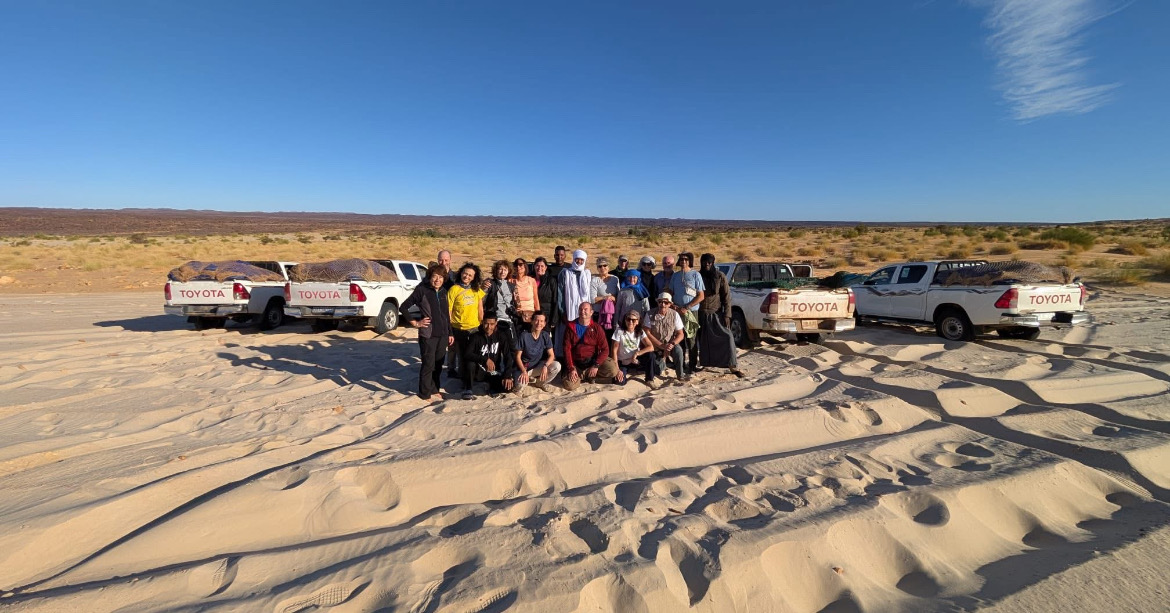
For most travelers without their own vehicle, hiring a 4x4 with an experienced local driver through an operator in Atar or Nouakchott is the standard and most practical approach to the Mauritanian circuit. This is not a compromise — it is simply how the Adrar is best explored.
A skilled driver in Mauritania brings far more than transport. They know the piste conditions (which change after sandstorms), the shortcuts, the fuel stops, the local contacts at SNIM for train timing, and the human network that makes desert travel function. They can source food and water in remote settlements where no formal shops exist.
Cost is typically 80–150 USD per day for the vehicle — a fixed cost that halves per person for two travelers and quarters for four. For groups, this is the most budget-efficient approach to the circuit.
Desert Navigation: GPS, Tracks, and Reality
The desert pistes in Mauritania are not marked the way European tracks or established African safari roads are. Many pistes are braided — multiple parallel tracks created by different vehicles over years, forking and rejoining without any indication of which is the correct route.
GPS with offline maps is essential. Maps.me, OsmAnd, or Gaia GPS with downloaded Mauritania OSM maps all work without mobile signal. Download everything before entering the desert. That said, GPS databases for Mauritanian desert tracks are not always current — sandstorms shift tracks and flash rains create new diversions. A local driver who knows the terrain provides a layer of navigation intelligence that no app replicates.
A satellite messenger (Garmin inReach or SPOT) provides SOS capability and location sharing from anywhere in the desert. For any self-drive overland journey in Mauritania, this device is strongly recommended.
What to Do If Your Vehicle Breaks Down
In a remote Mauritanian desert, a breakdown is a serious situation. There are no breakdown services, no recovery trucks, and no mobile signal to call for help in most piste areas.
Stay with the vehicle. A vehicle is visible from a great distance; a person on foot is not. Nomadic communities do pass through these areas, and local drivers routinely stop to assist stranded travelers — Mauritanian hospitality in the desert extends to practical help.
Use your satellite communicator to alert your emergency contact and, if required, initiate rescue. Save your travel insurance emergency number to the device before you set out. Carry enough water for 48+ hours per person as a breakdown buffer — this is the margin the desert demands, not an optional extra.
Ready to plan your Mauritania trip?
We handle transport, guides, logistics, and the Iron Ore Train.
Can I drive from Morocco to Mauritania in a standard car?
The Dakhla-to-Nouadhibou coastal route is passable in a reasonable standard car for the paved sections. The Adrar circuit (Atar-Chinguetti and beyond) requires a proper 4x4. Do not attempt piste sections without appropriate vehicle clearance and off-road capability.
Do I need a 4x4 or will a high-clearance SUV work?
A genuine 4x4 with low-range gearing and adequate clearance is required for the desert piste sections. High-clearance road SUVs without low range or with minimal off-road tyres are inadequate for serious piste conditions. When in doubt, hire a local vehicle.
What GPS maps work in Mauritania?
OsmAnd and Maps.me with downloaded Mauritania OSM data work offline. Gaia GPS is also reliable. Download before entering areas without mobile signal. No map replaces the knowledge of a local driver who knows the current piste conditions.
Plan Your Adventure
Book Your Mauritania Tour
We handle every detail — 4×4 transport with experienced local drivers, the Iron Ore Train boarding at Choum, ancient desert cities, and the guides who open the right doors. Tell us your dates and we'll build the right trip around you.