Getting Around Mauritania: Your Complete Transport Guide
Mauritania has almost no tourist-facing public transport. Understanding this before you arrive changes your planning entirely. Here is every transport option — what it costs, where it goes, and whether it's worth it.
The Transport Reality: Set Your Expectations
Mauritania does not have the transport infrastructure that most travelers expect from a country they want to explore. There is no tourist bus network. Ride-share apps don't exist outside Nouakchott. Train services run on a mining schedule with no tourist accommodation. Rental cars with off-road capability are not meaningfully available.
This is not unique to Mauritania among Saharan countries — it reflects a nation where 90% of the territory is desert, the population is sparse, and infrastructure has historically prioritised mining and essential goods movement over passenger tourism.
Understanding this before you arrive means you plan realistically. The main practical transport options are domestic flights, a 4x4 with driver, and the Iron Ore Train. Everything else — bush taxis, the occasional bus — exists but with severe limitations for tourist use. Our booking page can help you match the right transport combination to your itinerary.
Domestic Flights: The Best Option for Distance
Mauritania Airlines operates domestic routes connecting the three main cities: Nouakchott (NKC) to Atar (ATR) and Nouakchott (NKC) to Nouadhibou (NDB). Both routes take approximately one hour.
For travelers without their own vehicle and without time for overland transit, domestic flights are the most practical way to begin the Adrar circuit. The Nouakchott–Atar flight saves 9–10 hours of road travel each way. At 50–150 USD each way, it is a meaningful cost but consistently worthwhile.
Book domestic flights 2–4 weeks in advance. The aircraft are small (typically 50–70 seats) and fill with a mix of business travelers, government officials, SNIM workers, and tourists. They sell out. Mauritania Airlines operates with reasonable reliability on these routes, though delays occur — build schedule buffer around domestic connections.
Bush Taxis (Sept-Places): Cheap, Slow, Character-Building
The sept-place is a shared Peugeot 504 or similar vehicle that seats 7 passengers (hence the name) and operates between towns on a fill-when-full basis. There are no fixed departure times — the vehicle leaves when all 7 seats are sold.
Routes exist between Nouakchott and Atar, Nouakchott and Rosso (toward Senegal), and between other paired towns. The Nouakchott–Atar bush taxi takes 10–12 hours, costs approximately 15–25 USD, and delivers an authentically Mauritanian travel experience that no domestic flight can replicate.
For travelers with significant time flexibility and an interest in the journey itself, the bush taxi is a legitimate option for the main routes. It is not viable for any desert piste destination — Chinguetti, Terjit, Ouadane, or the Iron Ore Train line — where no shared taxis operate.
4x4 With Driver: The Standard Tourist Option
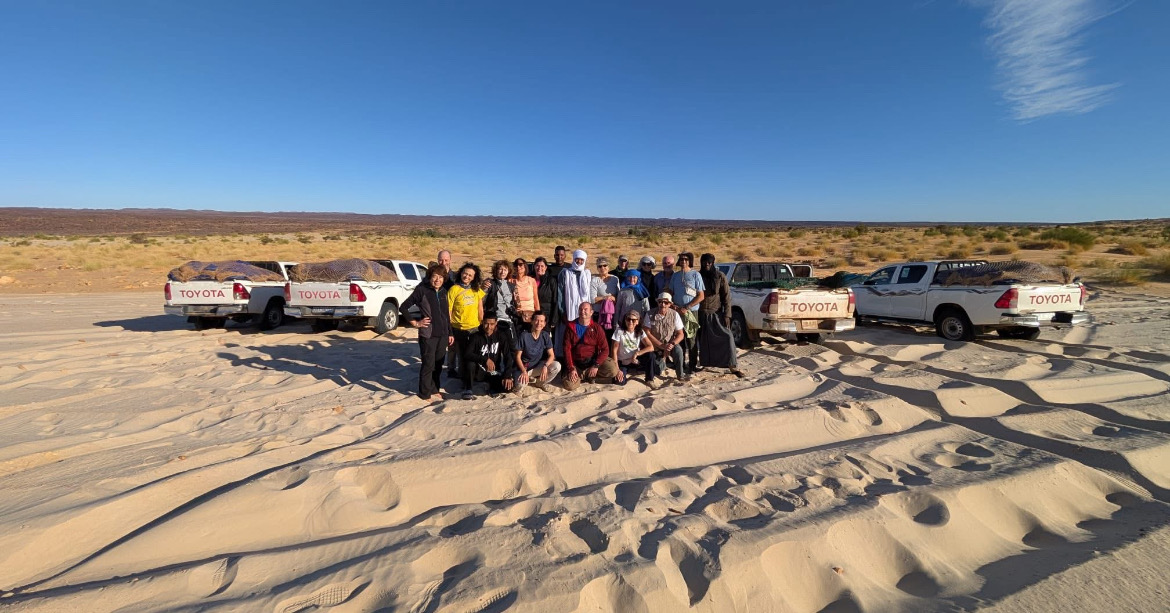
The 4x4 with driver is how most tourists cover the Mauritanian circuit, and it is the approach we recommend for the vast majority of travelers.
A capable local driver brings more than transport: piste knowledge (which changes after sandstorms), language (Hassaniya Arabic and French), and the social connections that open doors a solo traveler would find firmly closed. In Mauritania, the driver-guide is often the single most important element of the travel experience — an investment that pays off every day in the field.
Cost is typically 80–150 USD per day for the vehicle — a fixed cost covering fuel, driver, and vehicle operation. Solo travelers carry this as the dominant budget line; groups of three or four sharing the vehicle bring the per-person cost down considerably. Always arrange through a reputable operator rather than accepting casual approaches in Atar.
The Iron Ore Train: The Exceptional Case
The Iron Ore Train is the extraordinary exception to Mauritania's transport limitations — a genuinely singular crossing of 704km of Saharan desert from Zouerate to Nouadhibou.
For travelers, the train is boarded most practically at Choum (the midpoint), covering approximately 460km to Nouadhibou in 9–13 hours. The open iron ore wagons are free; the enclosed passenger carriage charges a small fee.
The Iron Ore Train is not primarily a transport utility for tourists — it is one of the defining experiences they come to Mauritania for. The night crossing, the limitless sky, the bitter cold, the dust, and the dawn arrival at the Atlantic are collectively one of the most remarkable journeys available anywhere on Earth.
Nouakchott Airport to City
Nouakchott Oumtounsy Airport is approximately 25km from the city center. Taxis are available outside arrivals — agree the price before getting in (typically 15–30 USD to central Nouakchott depending on your accommodation location and negotiating). There are no official meters.
Ride-share apps like Yango operate in Nouakchott with varying reliability — worth checking on arrival if you want a metered rate. No ride-share services operate in other Mauritanian cities.
For the return journey to the airport, ask your guesthouse or hotel to arrange a taxi the evening before. Morning airport taxis in Nouakchott can be harder to find than expected, and missing an international connection from Mauritania creates significant logistical problems.
Frequently Asked Questions
Can I use public transport to get to Chinguetti?
No. There is no public transport to Chinguetti, Terjit, Ouadane, or any desert destination. A 4x4 with driver is the only option. No bus, no shared taxi, no tour bus.
Is there a bus from Nouakchott to Atar?
Infrequent bus services exist but are not reliable for tourist use. The domestic flight (1h, 50-150 USD) or a 4x4 with driver are the practical options.
Can I rent a car in Mauritania?
Formal car rental barely exists in Mauritania, and no rental agency offers desert-capable 4x4s with the equipment needed for the Adrar circuit. Hiring a 4x4 with local driver through an operator is the standard approach.
Plan Your Adventure
Book Your Mauritania Tour
We handle every detail — 4×4 transport with experienced local drivers, the Iron Ore Train boarding at Choum, ancient desert cities, and the guides who open the right doors. Tell us your dates and we'll build the right trip around you.
- Iron Ore Train experience from Choum
- Chinguetti, Ouadane & the Richat Structure
- Terjit Oasis & full Adrar desert circuit
- Banc d'Arguin, Nouadhibou & the Atlantic coast
Keep Reading