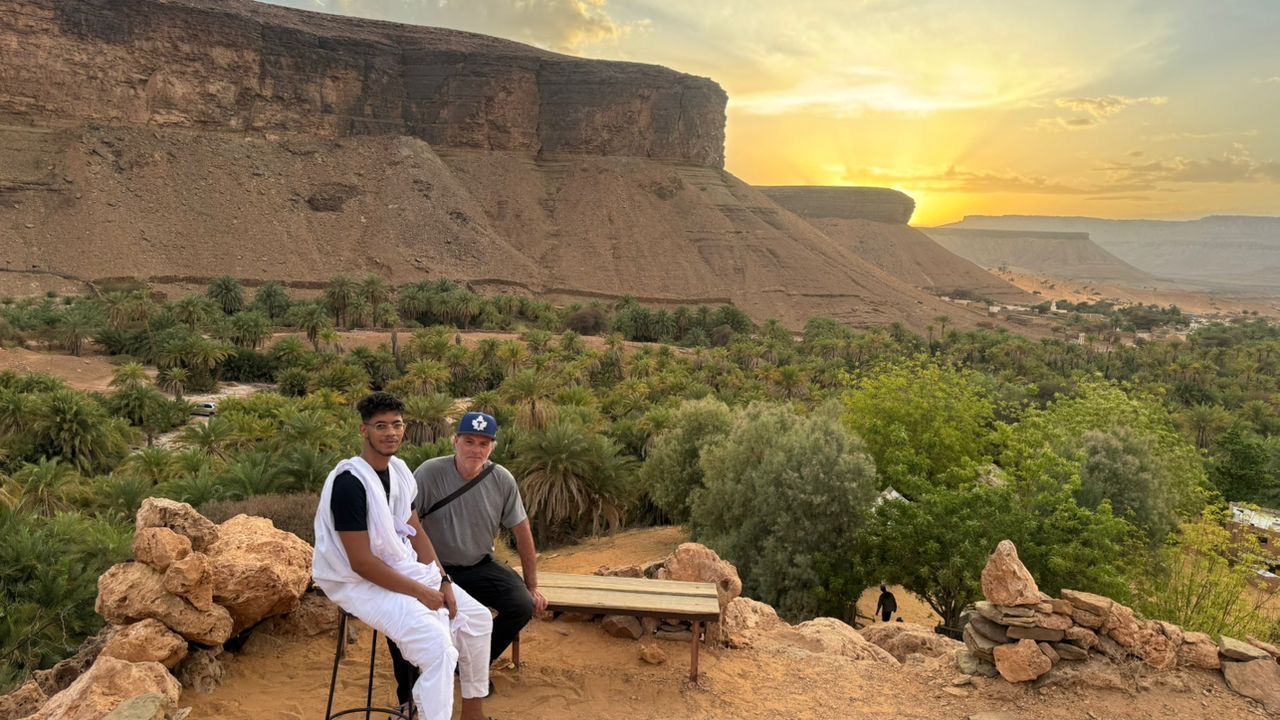
Ouadane: Mauritania's Most Remote and Rewarding Ancient City
Ouadane requires more effort than Chinguetti and rewards that effort with something rarer: the experience of a genuinely remote ancient city without other tourists, where the human interactions are natural and the sense of history is undiluted.
Being Honest About the Journey
Ouadane is approximately 95–100km from Atar by desert piste — a route that takes 3–4 hours in a capable 4x4 depending on conditions. It is significantly longer, rougher, and more remote than the Atar–Chinguetti piste, crossing open plateau desert with few landmarks and requiring a driver who knows the route well.
There is no shortcut to Ouadane. The distance and the piste are what keep it from the casual day-tripper tourism that has reached Chinguetti. The travelers who make it there are self-selected for persistence — and the experience they find is correspondingly undiluted.
This is not a guide designed to reassure you that Ouadane is easy. It isn't. It is the guide to explain why the difficulty is worth it and what you will find when you arrive.
The First Sight of the Ksar
Ouadane announces itself dramatically as you approach across the flat plateau. The ancient ksar (fortified city) sits on a rocky promontory above the surrounding desert — the ruined and partially standing structures of the old town visible against the sky before the settlement below becomes distinct.
The position is extraordinary. The old town sits on a rocky escarpment edge, and from the plateau surface the city appears to grow from the rock itself — earthen architecture the same colour as the stone beneath it, the mosque minaret the only vertical element interrupting the horizontal panorama.
Arriving in Ouadane after the long piste drive is one of Mauritanian travel's more satisfying moments — the effort justifies itself the instant the ancient city becomes real in front of you.
What Survives from the 12th Century
Ouadane was founded in 1147 CE — more than a century older than Chinguetti. The ksar that survives today is a mixture of intact, partially standing, and fully ruined structures representing various periods of the city's history from the 12th to the 18th centuries.
The Friday mosque is the most intact structure and one of the oldest continuously used mosques in West Africa. Still active for daily prayers and in use for nearly 900 years without interruption, it changes how you experience standing in its courtyard. The alleyways of the ksar are partially accessible — some sections consolidated and walkable, others in ongoing deterioration where entering requires care. Your guide knows which sections are stable.
UNESCO restoration work has addressed some of the most vulnerable structures. The restored sections are identifiable by different mortar and tighter stonework — visible alongside the genuinely ancient material they support.
The View From the Plateau Edge
The plateau edge at Ouadane provides what may be the finest unobstructed panorama in Mauritanian travel. Standing at the escarpment — either at the old town's outer wall or at a viewpoint your guide knows slightly beyond the ksar — the flat gravel desert stretches to the horizon in every direction except the rocky rise behind you.
From November through February, when the air is clear and the light clean, this view at sunrise or sunset belongs among the finest in the Saharan world. The desert floor is flat enough that the curvature of the Earth feels almost visible. The silence is absolute.
This moment — standing at the rim of an ancient city looking across a landscape unchanged in character for ten thousand years — is the defining experience of Ouadane. It requires no archaeological knowledge, no manuscript expertise, no cultural context to appreciate. It simply requires being there.
Manuscripts and Scholarly Tradition
Ouadane holds a smaller manuscript collection than Chinguetti but shares the same intellectual tradition. The families who maintained private libraries here were part of the same trans-Saharan scholarly network that made the ancient Adrar cities centres of Islamic learning.
Because Ouadane draws far fewer visitors than Chinguetti, a library visit here has a different quality. Your guide arranges an introduction to a family that maintains a collection; the meeting takes place in the family home rather than a dedicated exhibition space; the manuscripts are shown in their actual storage context rather than in display cases prepared for tourist groups.
This unscripted, intimate quality is one of the reasons serious travelers prefer Ouadane for the library experience. History feels more immediate when it has not been organised for your benefit. If you want to include Ouadane and its manuscript tradition in your trip, our booking page can help you plan accordingly.
Sleeping and Eating in Ouadane
Ouadane has very simple guesthouses — a handful of family establishments offering basic rooms, simple meals, and the level of infrastructure that 'remote ancient city' honestly suggests.
Expect: a mattress, blankets, solar electricity for a few hours in the evening (charge everything when the generator runs), meals of rice and vegetables or rice and meat prepared by the guesthouse family, fresh bread if you're lucky, and mint tea at every opportunity.
Do not expect hot water, WiFi, air conditioning, a varied menu, or any of the amenities that Atar's better auberges provide. Ouadane's accommodation exists because travelers need somewhere to sleep, not because tourism investment has made better facilities worthwhile.
Bring a sleeping bag even if your guesthouse provides blankets — desert nights are cold and the blankets may be thin. Bring a headtorch and your own toilet paper. These are the practical realities.
Why Ouadane Is Worth the Extra Effort
The honest answer to 'why bother with Ouadane when Chinguetti is closer?' is this: Chinguetti is extraordinary. Ouadane makes Chinguetti feel like a first chapter.
In Ouadane you encounter a city that has had almost no time to develop the habits of tourism — no vendors practised in which approach gets the sale, no standard tour route, no social script for your interaction. When locals are curious about you, it is genuine curiosity rather than the professional interest of a community that has learned to monetise traveler attention.
The view from the plateau edge, the mosque in continuous use for 900 years, the manuscripts encountered in their actual storage context, the total silence of the desert surrounding the ancient walls — none of these are better in Chinguetti. They are better in Ouadane because Ouadane is harder to reach, and the travelers who make it there arrive more ready to receive what the city offers.
Frequently Asked Questions
Is Ouadane worth visiting if I've already seen Chinguetti?
Yes. They are different experiences. Chinguetti is more polished and organized. Ouadane is rawer, more remote, and more authentic in the sense that the experience hasn't been shaped by years of tourist traffic. Serious travelers consistently prefer Ouadane for this reason.
How different is Ouadane from Chinguetti?
The historical character is similar — both are UNESCO ancient caravan cities with manuscripts. The experience is different: Ouadane has far fewer visitors, rougher access, and more genuine human interactions. The view from the plateau edge is arguably finer than anything in Chinguetti.
Can I visit Ouadane as a day trip from Atar?
Technically possible (200km round trip) but inadvisable — the 3-4 hour drive each way leaves very little time in Ouadane and is exhausting. One overnight minimum; two nights allows the Richat Structure excursion.
Plan Your Adventure
Book Your Mauritania Tour
We handle every detail — 4×4 transport with experienced local drivers, the Iron Ore Train boarding at Choum, ancient desert cities, and the guides who open the right doors. Tell us your dates and we'll build the right trip around you.
- Iron Ore Train experience from Choum
- Chinguetti, Ouadane & the Richat Structure
- Terjit Oasis & full Adrar desert circuit
- Banc d'Arguin, Nouadhibou & the Atlantic coast
Keep Reading