Desert Camping in Mauritania: How to Sleep Under the Saharan Sky
Sleeping in the open Mauritanian Sahara — a campfire, mint tea, the Milky Way overhead, and silence so complete you can hear your own heartbeat — is one of travel's genuinely transformative experiences. Here is how to do it properly.
Why Mauritania Is Exceptional for Desert Camping
Desert camping exists in Morocco, Egypt, Jordan, and dozens of other destinations with Saharan landscape. What sets Mauritania apart is scale and authenticity.
In Morocco's Erg Chebbi or Jordan's Wadi Rum, the camping areas are well-established, the operators are numerous, and the experience — while genuinely beautiful — has been organised for tourism. In Mauritania's Adrar desert, particularly around Chinguetti and in the open desert toward Choum, you can camp in complete isolation from any other traveler. No other camps visible on the horizon. No guided groups approaching from the other direction. Just the desert, your fire, and the sky.
The darkness is the other exceptional quality. The western Saharan interior has essentially zero light pollution — no city glow, no motorway lighting, no agricultural illumination. The sky at night in the Mauritanian desert is among the finest in the world: the Milky Way visible in full structure, the planets casting faint shadows on the dune sand, the stars close enough that the desert feels inside the universe rather than merely below it. Book a desert camping experience at mauritaniaexperience.com/book and see this sky for yourself.
Types of Desert Camping in Mauritania
Organized operator camp: your guide sets up a camp with sleeping mats or cots, a campfire, and simple meals prepared over the fire. Equipment is carried in the 4x4. This is the most practical introduction to desert camping — you have support for the logistics while experiencing the full sky and silence. Appropriate for all travelers with suitable clothing and sleeping gear.
Semi-organized: the guide handles the 4x4, the fire, and cooking; you provide your own sleeping kit — sleeping bag, mat, and personal items. This reduces what the operator carries and is often available at a lower cost.
Fully self-sufficient: experienced desert travelers with their own 4x4, complete camping equipment, navigation capability, sufficient water for multi-day camping, and satellite communication. This is for people who have done significant desert camping and understand the planning requirements. Not appropriate for first-time visitors without strong local knowledge.
The Campfire Experience
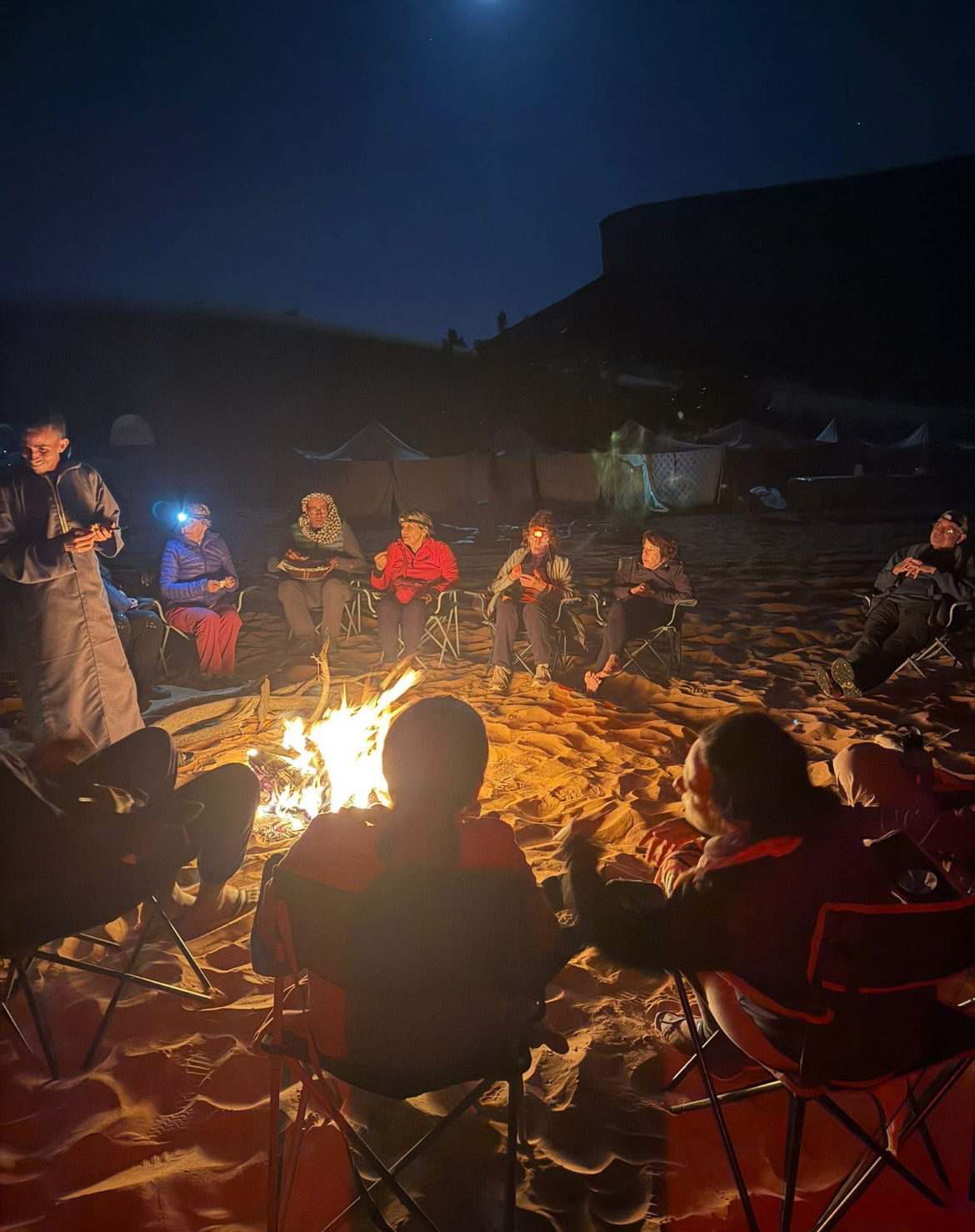
The campfire in the Mauritanian desert is not just a heat source — it is the social centre of the desert evening. Wood in the Sahara is scarce; your guide knows where to find it or carries some from the last settlement. The gathering around the fire, the preparation of tea in the small traditional pot, and the conversation that follows give shape to the evening.
The three-glass tea ceremony unfolds in its most natural context around a desert fire. The first glass takes 20 minutes to prepare — the tea brews slowly, the poured-and-returned process repeating until the strength is right. That wait is not time wasted. It is time inhabited.
In the coldest months (December–January), the campfire serves a genuinely practical warming function — the desert drops to 8–12°C after midnight and the fire becomes critical for comfort before the sleeping bag takes over. In October–November, the fire is more social than thermal but no less central to the evening.
Sleep Quality in the Desert
Most travelers who camp in the Mauritanian desert sleep better than they expect. The combination of physical tiredness from a day's travel, cool dry air, complete darkness, and profound silence produces sleep that arrives quickly and runs deep.
The desert is not completely silent — there are occasional sounds from insects and nocturnal animals, the creak of cooling rock, sand shifting in a gentle breeze. These are not disruptive sounds. They are the opposite of the ambient urban noise most travelers live within, and the brain adapts quickly to silence as something calming rather than unsettling.
Positioning matters. Sleeping on flat sand with a thin mat between you and the ground is more comfortable than it sounds — the sand conforms to your body in a way a hard camp cot cannot. The sleeping bag's insulation from below is the critical element; cold rising from the ground wakes you when cold from above does not.
Desert Camping Safety
Desert camping in Mauritania carries specific safety considerations that differ from camping in temperate environments.
Dehydration is the primary risk. Even in cool desert conditions, dry air draws moisture from your body faster than humid environments. Drink more than your thirst suggests and keep water accessible throughout the night.
Sandstorms occur most frequently at the end of summer into early October, and occasionally at other times. If one is approaching — visible as a dark wall of dust on the horizon — get low, cover your face and eyes completely, and shelter behind the 4x4 or within a terrain depression. Most sandstorms pass within minutes to hours.
Disorientation: never walk away from camp in the dark without a headtorch and a known compass bearing back. Dunes are identical in the dark and the desert is featureless — disorientation happens quickly. Stay within sight of the campfire.
Scorpions and snakes: shake out shoes and clothing before putting them on each morning. These are precautions rather than descriptions of common occurrences — encounters in desert camps are possible but not frequent.
Best Camping Locations
The dunes northeast of Chinguetti are the classic Mauritanian camping location — a 20–30 minute walk from the edge of town, completely isolated from any light source, and surrounded by some of the most photogenic dune terrain in the Adrar region. The combination of the ancient city silhouette and the sand sea is unique.
Open desert camping toward Choum — in the stretch between Chinguetti and the Iron Ore Train line — offers the most complete solitude. Hours from any settlement in any direction, the desert is at its most absolute here.
The Terjit Oasis area provides a different camping experience altogether — sheltered by canyon walls, with the sound of running water as a backdrop, and the stars visible through the canyon opening overhead. This is the gentlest introduction to desert camping in Mauritania.
Frequently Asked Questions
Can I camp in the Sahara without a guide?
Experienced desert travelers with their own 4x4, complete equipment, navigation capability, and satellite communication can camp independently. First-time desert campers should use a guide — not for regulation reasons but for safety and quality of experience.
What sleeping bag do I need for the Mauritanian desert?
November-March: rated to at least 5°C (comfort rating, not limit). December-January: 0°C or lower for comfort. The desert is colder than most travelers expect, especially combined with wind and open sleeping.
Are there dangerous animals in the Saharan desert of Mauritania?
Scorpions are present — shake out shoes and clothing in the morning. Horned vipers exist but are rarely encountered. Neither represents a significant risk with appropriate precautions. The main safety concerns are environmental (cold, dehydration, disorientation) rather than animal-related.
Plan Your Adventure
Book Your Mauritania Tour
We handle every detail — 4×4 transport with experienced local drivers, the Iron Ore Train boarding at Choum, ancient desert cities, and the guides who open the right doors. Tell us your dates and we'll build the right trip around you.
- Iron Ore Train experience from Choum
- Chinguetti, Ouadane & the Richat Structure
- Terjit Oasis & full Adrar desert circuit
- Banc d'Arguin, Nouadhibou & the Atlantic coast
Keep Reading